
Some houses catch your attention before you even know why. A corner turret rising above the roofline. A wraparound porch with turned spindles and jigsaw-cut brackets. Fish-scale shingles layered under a steep gable, and windows of different shapes and sizes arranged as if the house grew them on purpose. In Paris and across Northeast Texas, those houses are usually Queen Annes, and they are among the most expressive architecture the region has to offer.
This guide explains what defines a Queen Anne, how the style and its Eastlake cousin show up in Northeast Texas, where the survivors of Paris's great fires still stand, and what buyers should investigate before owning one. If you are weighing a character home, our historic homes page covers how we represent heritage properties, and Buying a Historic Home in Paris, TX walks through districts, guidelines, and incentives in practical detail.
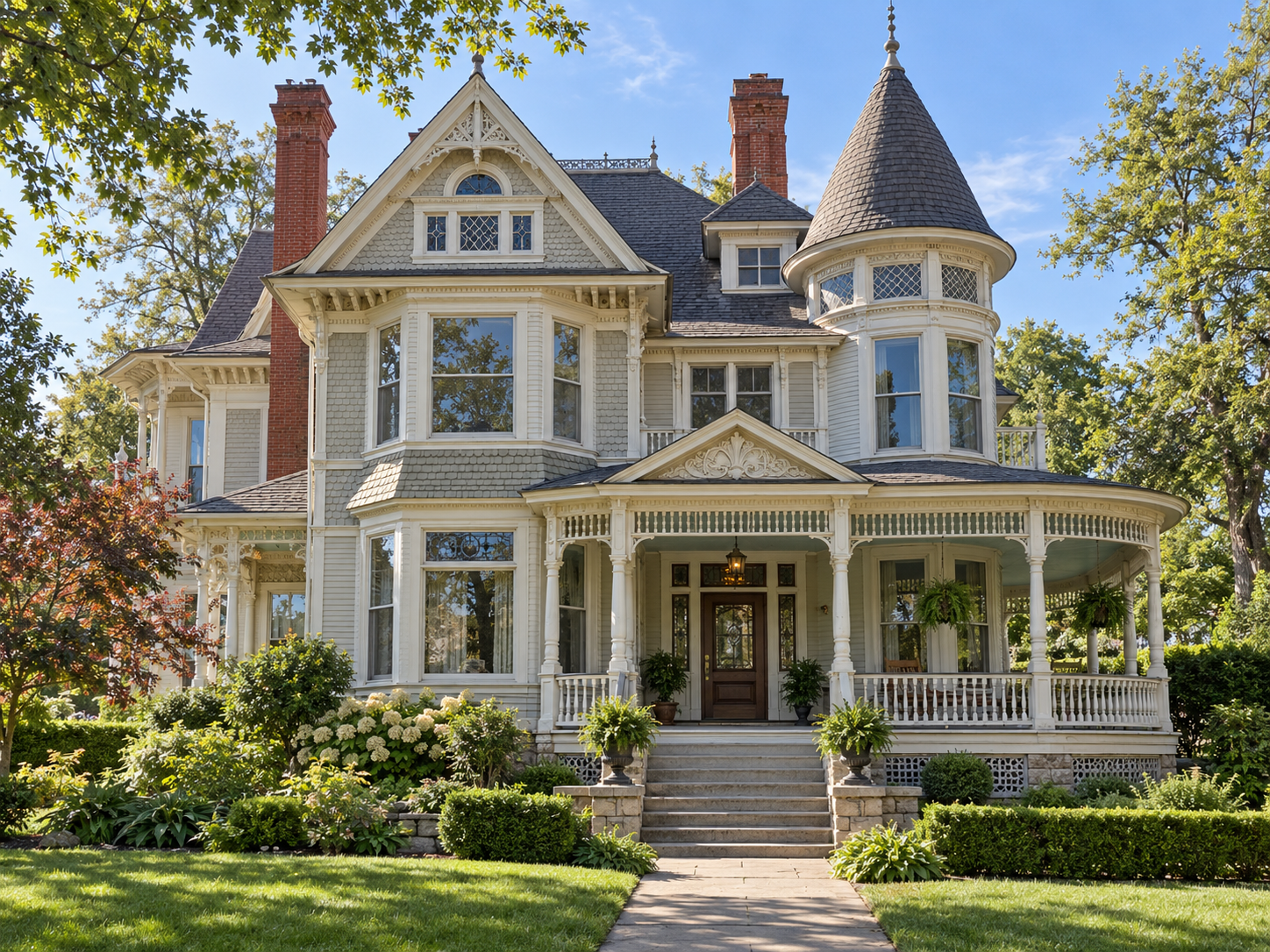
What Defines a Queen Anne
The Queen Anne style is not one look. It is an approach to composition that prizes asymmetry, texture, and variety over symmetry and restraint. A true Queen Anne typically combines several of these features:
- A steeply pitched, irregular roofline with multiple gables
- A prominent front-facing gable or a corner tower with a conical or pyramidal roof
- A wraparound porch supported by turned posts and decorative spindles
- Fish-scale or patterned shingles in the gable fields
- Mixed cladding, often wood siding with shingle or brick accents
- Windows of varied shapes, including bay windows, oriel windows, and one-over-one sash
- Cutaway bays, sunburst motifs, and carved or incised ornament
Despite the name, the style has little to do with Queen Anne of England. American builders popularized it in the 1880s and 1890s through pattern books and, in many small towns, through lumber catalogs shipped in on the railroad. The result was a style that could be as grand as a city mansion or as modest as a farmhouse with a single gable and a porch, and both extremes survive in Northeast Texas.
Queen Anne and Eastlake
Walk past a Queen Anne in Paris and you will often hear two names used together: Queen Anne and Eastlake. The Eastlake movement, named for the English design reformer Charles Eastlake, emphasized machine-cut ornament made from turned wood: geometric spindlework, incised lines, and repetitive carved details. Where a pure Queen Anne might rely on massing and shingle texture, an Eastlake treatment adds layers of turned and cut decoration to the porch, the gables, and the eaves.
In practice, the two styles blurred. Many Northeast Texas houses combine Queen Anne massing with Eastlake detailing, and the same house is often described both ways in old records and National Register documentation. For buyers, the distinction matters less than the condition of the ornament itself, because turned spindles and cut brackets are exactly the pieces that rot, crack, and go missing first.
The Survivors of Paris
Paris has burned twice, and the fires define what survives today. The fire of 1877 destroyed much of the young city, and the far larger fire of 1916 swept through downtown and the surrounding residential streets, leveling blocks of frame construction. The Texas Historical Commission Atlas Historic Resources of Paris multiple property listing documents how the rebuilding that followed reshaped the city's architectural character.
Because the 1916 fire consumed so much of the existing housing stock, the historic districts that remain are predominantly post-1916 landscapes. The Pine Bluff-Fitzhugh Historic District, listed on the National Register in 1988, is a good example: most of its homes date from the rebuilding years, with Queen Anne, Eastlake, and Craftsman houses standing side by side. The district's National Register documentation describes the surviving Victorian-era houses and the later infill that gives the neighborhood its layered character.
A few houses made it through both fires, and they are the region's most important survivors. The Atkinson-Morris House at 802 Fitzhugh Avenue, built about 1890, is a Queen Anne with Eastlake and Stick detailing, and it was listed on the National Register in 1988. It stands as one of the clearest examples of the region's pre-fire Victorian architecture, and it anchors the historic character of the Pine Bluff-Fitzhugh neighborhood.
Why These Homes Matter
Queen Annes are irreplaceable in a way that newer construction is not. The longleaf pine framing, the handmade brick, the turned spindles cut from old-growth lumber, and the craftsmanship of builders who worked without power tools cannot be reproduced at any reasonable cost. When a Queen Anne is lost, the region loses a piece of its rebuilding story, the story of a city that burned twice and rebuilt with ambition.
These homes also anchor their neighborhoods. Historic districts with intact Victorian stock tend to hold their value, attract preservation-minded buyers, and give a community a sense of place that new subdivisions cannot manufacture. Owners who maintain their Queen Annes are not just caring for a house; they are caring for the character of the street.
What Buyers Should Investigate
A Queen Anne is beautiful, and it is also one of the most complicated houses you can buy. Before you fall in love, investigate these areas:
- Foundation and structure. Most of these homes sit on pier and beam foundations. Look for settling, insect damage, and rot in the floor joists, and have a structural assessment done before you commit.
- The roof. Queen Anne rooflines are full of valleys, dormers, and turret intersections where water collects. Ask about the age of the roof and check for past leak repairs.
- Porch systems. The wraparound porch is the style's signature, and it is also the most exposed. Inspect posts, spindles, floor decking, and steps for rot and termite damage.
- Windows. Original wavy glass, sash cords, and weights are valuable and fragile. Count how many original windows survive and what replacement would cost.
- Mechanical systems. Knob and tube wiring and galvanized plumbing are common in pre-war homes. Budget for modernization, and ask your agent how inspections differ for older and historic homes.
- Insurance. Carriers treat century-old homes differently. Learn whether historic homes are more expensive to insure before you make an offer.
Renovation adds another layer. The rules for working on a designated historic home are specific, and our guide on Renovating a Historic Home in Paris, TX covers permits, contractors, and incentives in detail.
National Register, Local Designation, and Restrictions
Two kinds of historic status get confused, and the difference matters to owners. A National Register listing is primarily honorary. By itself, it generally does not restrict what a private owner can do with a house: owners of listed properties may alter, renovate, or even demolish their homes without federal permission. Restrictions can come from other directions, however. Local historic district designation, preservation easements written into the deed, or federal involvement in a project can all impose requirements.
In Paris, the Historic Preservation Commission oversees the designated historic districts and reviews exterior changes through a Certificate of Appropriateness process. The city's ordinance draws a practical line between ordinary maintenance and alterations. Routine upkeep, such as painting in kind or repairing a porch in kind, does not typically require a Certificate of Appropriateness. Material alterations, additions, and demolition do.
If a project involves federal funding, licensing, or permits, Section 106 of the National Historic Preservation Act may trigger a review of the project's effect on historic properties. When rehabilitation work is part of the plan, the Secretary of the Interior's Standards for Rehabilitation are the accepted reference for what counts as appropriate work. Owners of qualified historic properties may also be able to use the city's historic property incentives, which can offset the cost of approved preservation work.
The same questions come up in every historic transaction, and we have answered the common ones in our Answer Book: the difference between an old home and a designated historic home, whether you can renovate a historic home however you want, whether historic homes are more expensive to insure, and how inspections differ for older and historic homes.
Frequently Asked Questions
Are Queen Anne homes common in Northeast Texas?
Queen Anne is one of the most common Victorian styles in the region's older neighborhoods, but most of what survives dates from after the 1916 fire. Pre-fire examples such as the Atkinson-Morris House are rare and especially significant.
What is the difference between Queen Anne and Eastlake?
Queen Anne describes the overall composition: irregular rooflines, towers, porches, and mixed textures. Eastlake describes the machine-cut ornament, such as turned spindles and incised brackets, that often decorates those forms. Many houses combine both.
Do I need a Certificate of Appropriateness to paint my historic home in Paris?
Painting in kind, meaning the same color and finish, is ordinary maintenance and does not typically require a Certificate of Appropriateness. A material change, such as a new color scheme or a change in finish, may require review. Confirm the current rules with the Historic Preservation Commission before you start.
Does National Register listing restrict what I can do with my house?
Not by itself. The listing is honorary and generally does not restrict private owners. Local district designation, deed restrictions, or federal involvement in a project can create separate requirements.
Are historic homes more expensive to insure?
Often, yes. Carriers may require higher coverage for replacement of period materials, and some insurers decline older homes altogether. Get quotes from carriers that specialize in historic properties and compare before you buy.
Are inspections different for older and historic homes?
Yes. A standard inspection is a starting point, but older homes need specialized review of the foundation, wiring, plumbing, and period materials. Work with inspectors who know pre-war construction.
Ready to explore the Queen Annes of Northeast Texas?
Whether you are drawn to a corner turret or a wraparound porch, a Queen Anne is a decision worth making with local guidance. Call us at (903) 785-2005 or stop by our office at 2322 Lamar Ave. in Paris to talk about the historic homes you have been watching. If you own one and are thinking about the next chapter, our guide on selling historic homes explains how we market heritage properties.
Contact UsShannon Miles Group
eXp Realty | Paris, TX
Shannon and Scott Miles are a husband-and-wife real estate team serving Northeast Texas. Shannon is a Certified Luxury Home Marketing Specialist (CLHMS), and both are New Construction, Land, and Ranch Specialists who bring deep local knowledge to every type of transaction, including historic properties across Lamar County and beyond.