
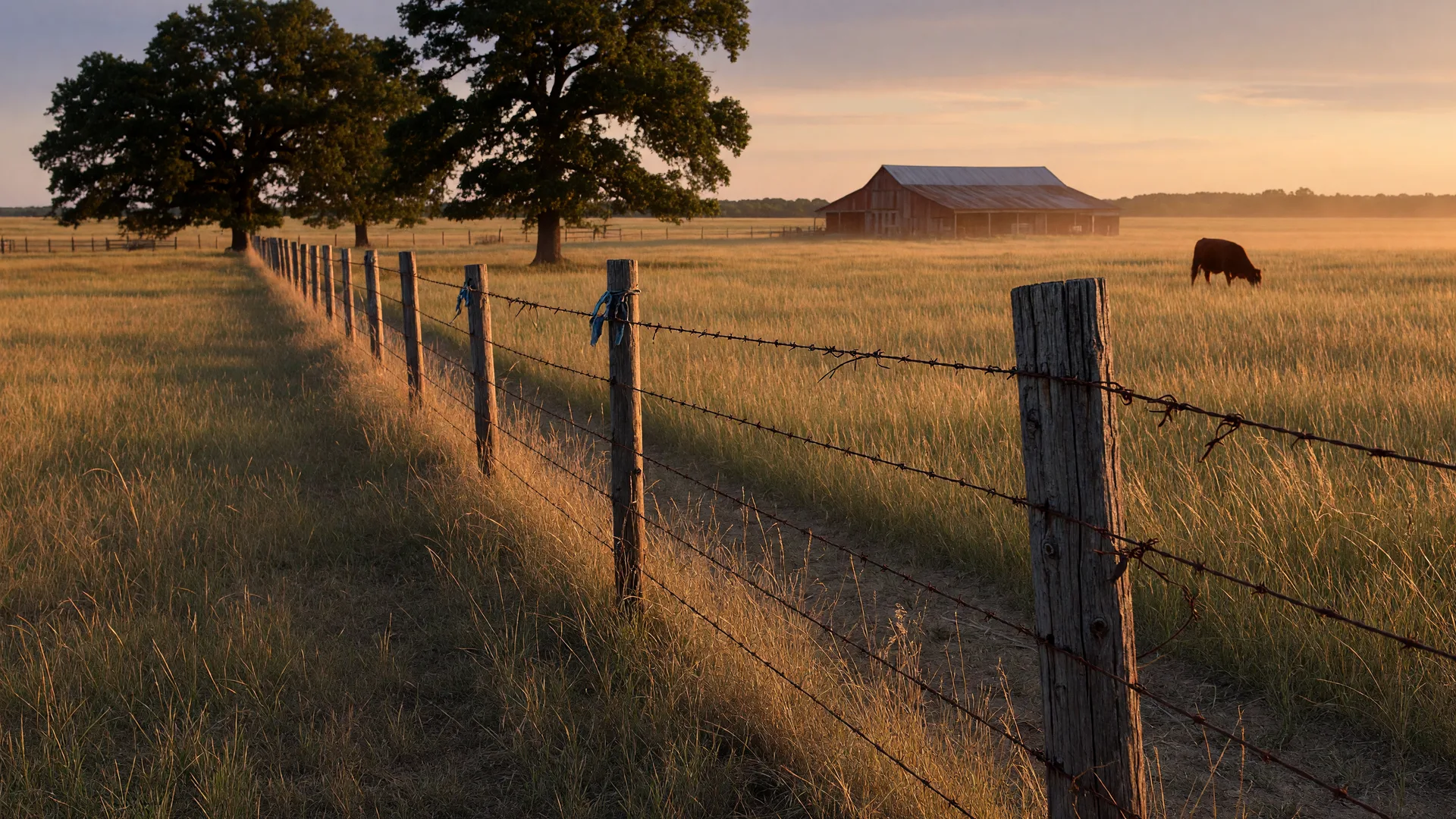
In Texas, no state law requires a neighbor to help pay for or maintain a boundary fence unless the two of you agree to it. Texas is an open range state by default, which means the landowner who wants livestock kept out is usually the one who builds and maintains the fence that does the job. The rule flips in counties and precincts that have voted to become closed range, so this is a question you verify for your specific tract rather than assume.
Fencing is one of the most expensive improvements on a farm or ranch, and the fence on your line is only as good as the agreement and the law behind it. Here is how Texas fence law actually works, where Oklahoma is different, and what to check before you buy acreage in Northeast Texas.
Texas has no statute that says neighbors must split the cost of a boundary fence. Responsibility is set by agreement, by who built the fence, and by local rules. Texas is open range by default: livestock may run at large, and a landowner who wants them kept out fences them out. Some counties and precincts have adopted stock laws that flip the rule to closed range, where livestock owners must fence their animals in. All interstate and state highways are closed range. Across the border in Oklahoma, the whole state is closed range under the Herd Law, so the fence-in duty belongs to the livestock owner.
Why this matters when you buy rural land
When you buy a house in town, the fence question is usually cosmetic: who owns the fence, who maintains it, and whether the neighbor agrees. When you buy acreage, the fence question is operational. A fence is what keeps the neighbor's cattle out of your yard, keeps your cattle in, protects your garden, and defines where your responsibility starts and ends. If the fence on the line is old, poorly built, or owned by someone who will not maintain it, you are buying a problem, not just a boundary.
That is why the legal side matters as much as the physical side. Our guide to evaluating fence condition on a farm or ranch covers posts, wire, tension, and gates. This guide covers who is legally on the hook for the fence itself.
Texas is open range by default
Under Texas common law, Texas is an open range, or fence-out, state. A livestock owner has no general legal duty to keep animals off neighboring land or roads. The landowner who wants to keep livestock out must build and maintain a fence sufficient to do the job. In practice, that means if you buy a place next to a cattle operation and you do not want those cattle in your yard, the fence that keeps them out is generally your responsibility unless you and the neighbor agree otherwise.
This is the opposite of what many buyers expect, especially buyers coming from suburban neighborhoods where the developer or the HOA built the fence. On open range land in Northeast Texas, the default assumption is that animals can roam, and the burden sits with the landowner who wants them excluded. If you are weighing whether a tract works for running cattle of your own, the fence question cuts both ways: you need fences that hold your animals in and, where the county requires it, keep the neighbor's animals out.
Closed range counties and stock law elections
Since 1876, Texas law has let counties hold stock law elections. Today those rules live in Chapter 143 of the Texas Agriculture Code. When a county, or a precinct within it, adopts a stock law, that area becomes closed range, also called fence-in. Livestock owners then have a duty to keep their animals enclosed, and they can be responsible for damage when animals get out.
The details matter. Stock laws can cover some species and not others, can apply to a whole county or only certain precincts, and were adopted at different times in different places. Roughly 60 percent of Texas counties have adopted some form of stock law. That is why you cannot generalize from one county to the next, and why the status for a specific tract has to be verified rather than assumed.
For a tract in Lamar County, the reliable way to confirm is to ask the Lamar County Commissioners Court or the County Clerk whether a stock law applies to that precinct, and to cross-check a published county-by-county stock law chart. We cannot tell you from a map whether your specific tract is open range or closed range, and neither should anyone else. It is a tract-level question, and it takes five minutes to verify with the county.
The highway rule
Even in open range territory, all interstate and state highways are closed range. Owners may not knowingly allow livestock to roam at large on a highway. That includes the farm-to-market roads that crisscross Northeast Texas, which are part of the state highway system. If you buy land that fronts a state highway or an FM road, fencing along that frontage is not just about keeping animals in or out of your pasture, it is about keeping them off a road where the owner can be held responsible.
Who pays for a boundary fence between neighbors?
Texas has no statute that tells neighbors how to share a boundary fence. Court decisions establish that a landowner has no obligation to contribute to the cost or maintenance of a fence built by a neighbor unless there was a prior agreement to do so, even if the fence is later destroyed by natural causes. In practice, responsibility follows whoever built the fence and whatever the two owners agreed to.
That is why a written fence agreement is worth having. A simple agreement can record who owns the fence, who maintains it, what it is built to keep in or out, and what happens when it needs repair. It does not have to be complicated, but it should be in writing and signed by both owners. Some cities and subdivisions have their own fencing rules, and recorded covenants can add requirements, so check those too before you assume a fence can go where you want it.
If you are looking at a property where the fence line matters, our answer on neighboring farms, ranches, and livestock operations walks through the questions to ask about the operations on the other side of the line.
What to check before you buy
Fence responsibility is a due diligence item, not a surprise you want after closing. Here is the checklist we walk with land buyers:
- Get the survey. Fence lines do not always match property lines, and an old fence can sit several feet off the true boundary. A current survey tells you where your line actually is before you invest in a fence. See our guide on whether you need a survey when buying land in Texas.
- Walk the fence line. Note who built the fence, what it is made of, and its condition. A fence that is already failing is a future expense, and our fence evaluation guide tells you what to look for at each post and wire.
- Confirm the county and precinct stock law status. Ask the county clerk or commissioners court whether a stock law applies to the tract, and check a published stock law chart. This determines who has the fence-in duty.
- Ask about recorded agreements and easements. A fence maintenance agreement between the current owner and a neighbor may or may not transfer with the land, and an easement can affect where a fence can go. Our guide to easements before buying land covers what to look for.
- Check deed restrictions. Some tracts carry covenants about fence type, height, or materials, especially in newer rural subdivisions. Our answer on finding out if land has deed restrictions shows where to look.
- Talk to the neighbors. The people on the other side of the fence know the history: who built it, who has maintained it, and whether the county treats the area as open or closed range in practice.
Most of this is simple to check, it just has to be checked. If you are weighing a tract and want to know how the acreage is laid out and what the usable ground looks like, our guide to acreage in Northeast Texas is a good place to keep going.
Texas versus Oklahoma: the fence-in state
The rules change at the state line. Oklahoma is a fence-in state under the Oklahoma Herd Law. All domestic animals must be restrained by their owner at all times and seasons, and the owner is liable for damages caused by animals trespassing on another's land. Oklahoma statutes also hold a livestock owner liable for damages done by animals breaking through or over lawful fences and trespassing on enclosed land, and a lawful fence is defined by statute, typically barbed-wire fences meeting strand and height requirements.
The practical difference for buyers is this: in Oklahoma the burden sits with the livestock owner to keep animals in, while in open range parts of Texas the burden sits with the landowner to keep animals out. If you are comparing tracts on both sides of the line, our comparison of buying rural property in Texas versus Oklahoma covers the other differences too, and our guide for Texas buyers looking at Oklahoma land walks through what to verify before you cross the border.
The bottom line
Fence responsibility is a legal question, not a real estate question, and the answer is specific to your tract, your county, and your agreements. Texas is open range by default, some counties and precincts are closed range, highways are always closed range, and Oklahoma is closed range statewide. Verify the stock law status for the exact tract, get the survey, walk the fence, and put any shared arrangement in writing.
If a fence dispute ever arises, an attorney who practices in your county is the right person to sort it out. What we can do is point you to the county offices, help you read a survey, walk the fence line with you before you buy, and connect you with local fencing contractors. That is part of the land and ranch service we provide across Lamar County and the rest of Northeast Texas, and it is why we ask the fence question on every acreage showing.
This guide draws on primary and institutional sources. Fence and livestock law is state specific and changes with local elections, so always confirm the current status for your exact tract with the county.
- Texas State Law Library, Fences and Boundaries
- Texas State Law Library, Livestock
- Texas A&M AgriLife, Texas Ag Law Blog: Texas Fence Law, Open Range or Not?
- Texas & Southwestern Cattle Raisers Association, Livestock Laws
- Matthiesen, Wickert & Lehrer, Texas Stock Laws by County
- Oklahoma State University Extension, Fence Law and Pasture Leasing in Oklahoma
- National Agricultural Law Center, States' Fence Statutes: Oklahoma
Frequently Asked Questions
Who is responsible for the fence between neighbors in Texas?
Texas has no statute that requires neighbors to share the cost or maintenance of a boundary fence. Responsibility is set by agreement, by who built the fence, and by local rules. Texas is open range by default, so a landowner who wants livestock kept out usually builds and maintains the fence that does the job. Some counties and precincts have adopted stock laws that flip the rule to closed range.
Is Texas an open range or closed range state?
Texas is open range by default. Livestock owners have no general duty to keep animals off neighboring land, so landowners who want them kept out must fence them out. Counties and precincts can adopt stock laws under Chapter 143 of the Texas Agriculture Code, which makes that area closed range and puts the fence-in duty on the livestock owner. All interstate and state highways are closed range.
Does Lamar County have a stock law?
That status has to be verified for the specific county and precinct. Texas is open range by default, and many counties have adopted stock laws, so the only reliable way to know is to confirm with the Lamar County Commissioners Court or County Clerk, or check a published county-by-county stock law chart. Never assume open range or closed range for a specific tract.
Who pays if a boundary fence needs repair?
Unless the two owners agreed otherwise, Texas case law says a landowner has no obligation to contribute to the cost or maintenance of a fence built by a neighbor, even if it is destroyed by natural causes. A written fence agreement between the owners is the way to make the responsibility clear and enforceable.
Is Oklahoma open range or closed range?
Oklahoma is closed range statewide under the Oklahoma Herd Law. All domestic animals must be restrained by their owner at all times, and the owner is liable for damages caused by animals trespassing on another's land. In Oklahoma the burden sits with the livestock owner to keep animals in, unlike open range parts of Texas where the burden sits with the landowner to keep animals out.
Ready to find your place in Northeast Texas?
Whether you are buying acreage, a farm, or a ranch, we will help you check the survey, the fence line, and the county rules before you make an offer. Call (903) 785-2005 or send us a message.

Shannon Miles Group
eXp Realty | Paris, TX
Shannon and Scott Miles are a husband-and-wife real estate team serving Northeast Texas. As founding members of the eXp Land and Ranch Division, they specialize in land, ranch, residential, commercial, and new construction across Lamar County and beyond. More land and rural property answers live in the Rural Property section of the SMiles Answer Book.