
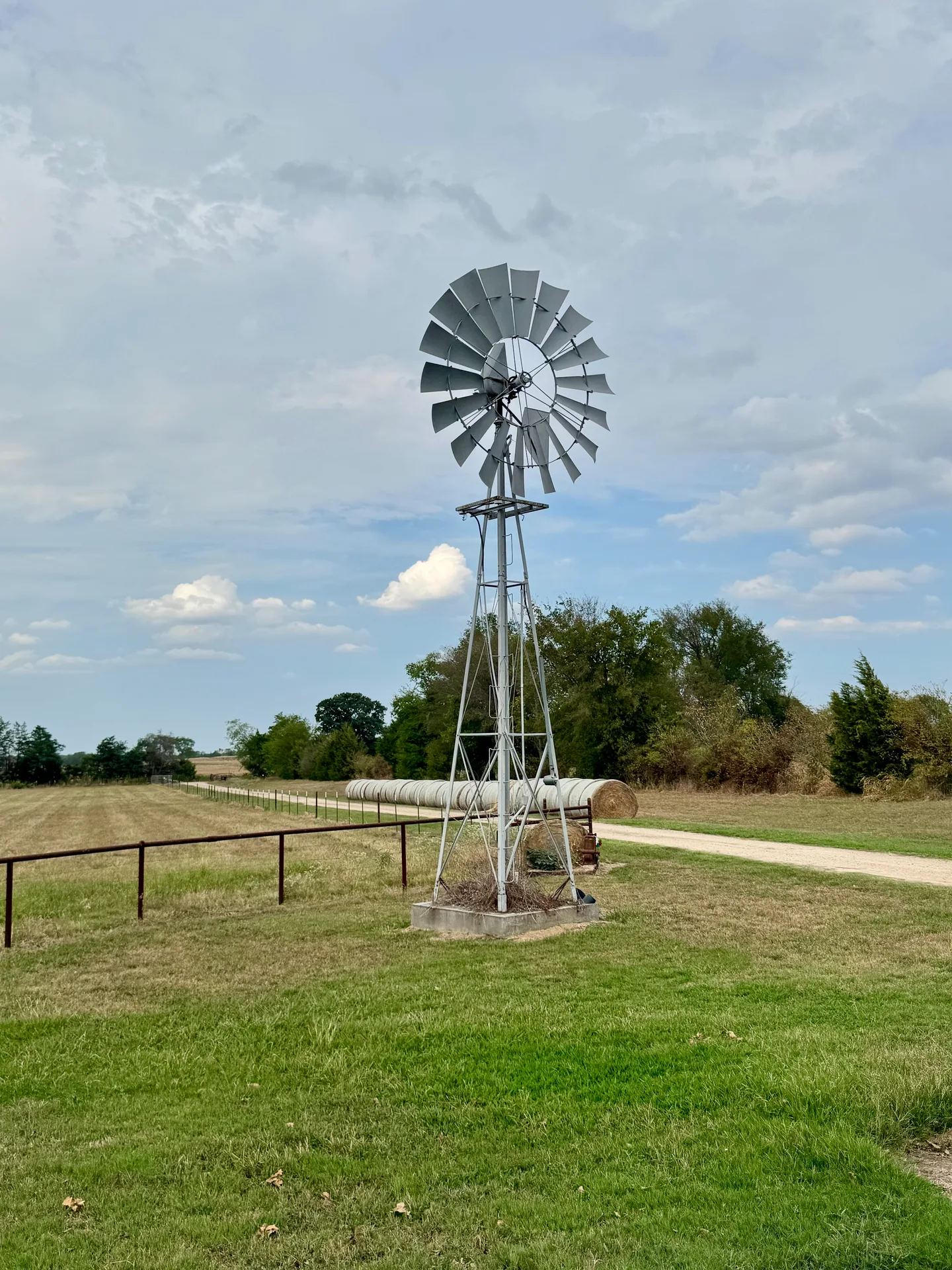
In most of Lamar County, you do not need a county or groundwater district permit to drill a domestic water well, because Lamar County is not located inside a groundwater conservation district. Statewide rules still apply: the well has to be drilled by a licensed well driller, and the driller files a well report with the state after completion. The answer changes by county and by state, so the reliable habit is to verify the rules for your exact tract before you drill.
Water is the first question on any piece of rural land, and the well is usually the answer. Whether you are buying a home with an existing well or raw acreage where you will drill your own, the permit question comes up early, and the honest answer is that it depends on where the land sits. Here is how well drilling rules actually work in Northeast Texas, where Oklahoma is different, and what to check before you buy.
Texas does not have a statewide permit for domestic water wells. Permits come from local groundwater conservation districts, and only about 100 of Texas's 254 counties sit inside one. Lamar County is not one of them, so no district permit is needed for a domestic well there. In Fannin and Grayson Counties, the Red River Groundwater Conservation District requires all new wells, including domestic and livestock wells, to be registered and to obtain a Notice to Proceed before drilling. Across the border, Oklahoma exempts domestic wells from water-use permitting but requires a licensed driller and a completion report, and non-domestic uses need an OWRB permit. Every tract gets verified, never assumed.
Why this matters when you buy rural land
A well is one of the most valuable improvements on a rural property, and it is also one of the most regulated. When you buy a home with a well, you want to know the well is legal, recorded, and built to current standards. When you buy raw land, you want to know what it will take to get water to your homesite, and whether any permits or registrations stand between you and the first drill bit.
The permit question is really a water-rights question in disguise. Texas treats the groundwater beneath your land as a private property right, but local districts can add rules on top of that right. Our answer on whether you own the water under your land in Texas explains the ownership side, including the rule of capture and how districts change the picture. This guide covers the practical side: what you need before you drill, county by county.
Lamar County: no groundwater district, no county well permit
Lamar County is not located inside a groundwater conservation district. Groundwater districts are the only local bodies in Texas that can require well permits, so in Lamar County there is no district permit to obtain for a domestic well. You also will not find a county-level well permitting office for a routine household well, because the county does not administer well drilling in the way it administers septic systems.
That does not mean the well is unregulated. Two statewide requirements always apply:
- The driller must be licensed. Texas requires water wells to be drilled by a licensed well driller, and the driller must follow state construction standards for casing, sealing, and disinfection.
- A well report is filed. The driller files a well report with the state after the well is completed, recording depth, casing, and often the initial flow and water quality. That report is your proof of what the well is.
The Texas Water Development Board's groundwater FAQ is a good place to start for the statewide picture, and the Texas Groundwater Protection Committee's water well pages explain construction standards and driller requirements in plain language.
Fannin and Grayson Counties: the Red River Groundwater Conservation District
Drive south or west out of Lamar County and the rules change. Fannin and Grayson Counties sit inside the Red River Groundwater Conservation District, and the District requires all new water wells, including domestic and livestock wells, to be registered with the District and to obtain a Notice to Proceed before drilling and operation.
Here is the nuance that trips up buyers: domestic and livestock wells are exempt from a production permit under Texas Water Code Section 36.117, but exempt does not mean unregistered. The District still requires the registration and the Notice to Proceed, and it notes that unregistered exempt wells are not protected under its rules from impacts caused by new wells. In practical terms, an unregistered well in the District has less legal standing than a registered one.
The District's rules also include a pre-effective-date exemption: domestic and livestock wells, or wells with a capacity under 27.7 gallons per minute, drilled before April 1, 2012, are not required to be registered. If you are buying land in Fannin or Grayson County with an older well, ask whether it falls under that exemption, and confirm the current rules with the District directly, because rules can be amended.
The rest of Northeast Texas: verify the county
The counties we serve across Lamar, Red River, Delta, Hopkins, Hunt, and the surrounding area are mostly not inside active groundwater districts, which keeps the rule of capture governing day to day well use there. But district boundaries are not permanent. New districts can be created, and existing districts can expand or change their rules, so the reliable habit is to confirm the current status for the specific county before you buy.
Two other checks belong on your list. First, ask whether the county has any local rules about well location, setbacks from septic systems, or well construction beyond the state minimums. Second, if the property sits near a county line, confirm which county the tract is officially in, because the district situation can change from one side of a road to the other. Our guide to what to know before buying land in Northeast Texas walks through the full due diligence list, and the Lamar County land and rural property guide covers the local specifics.
Oklahoma: domestic wells exempt, but not unregulated
If you are looking at acreage in Southeast Oklahoma, the rules are different again. Oklahoma exempts domestic groundwater wells from Oklahoma Water Resources Board water-use permitting. Domestic use means household purposes, water for farm and domestic animals up to the land's grazing capacity, and irrigation of less than 3 acres. For those uses, no OWRB water-use permit and no intent-to-drill approval is required.
But the well itself is still regulated. The well must be drilled by an OWRB-licensed well driller, any pump must be installed by a licensed pump installer, construction must meet OWRB standards for location, setbacks, sealing, and disinfection, and the driller files a Well Completion Report for the finished well. Some Oklahoma cities require a separate local well registration or drilling permit, so check the local municipality too.
The line that matters in Oklahoma is domestic versus non-domestic. Irrigation beyond 3 acres, commercial supply, public water supply, and other non-domestic uses require a groundwater permit and intent-to-drill approval from OWRB before drilling. The OWRB wells and licensing page and its water permit application page are the authoritative places to check. For the broader picture, our guides on what Texas buyers should know before buying land in Oklahoma and the differences between buying rural property in Texas and Oklahoma cover the other border-state differences.
What to check before you buy
Well permitting is a due diligence item, not a surprise you want after closing. Here is the checklist we walk with land buyers:
- Confirm the county and district status. Is the tract inside a groundwater conservation district? Ask the district or the county directly, and do not assume based on a neighboring property.
- Ask for the well report. If the property has an existing well, get the driller's report, which records depth, casing, drilling date, and often the initial flow and water quality. Our guide to buying a property with a private well explains what to ask for, and what to have inspected on a private well covers the professional evaluation.
- Plan for water quality and quantity testing. A permit tells you the well is legal; it does not tell you the water is good. Testing and a flow test are separate steps, and our answer on well water testing before buying walks through both.
- Know the difference between a well and community water. Some rural tracts are served by a water supply corporation instead of a well, and the two are very different to own. Our comparison of private wells versus community water helps you tell them apart, and our guide to what utilities are available on rural property covers the full utility picture.
- Budget the well into the deal. If the land has no well, drilling and equipping one is a real cost that varies by depth and geology. Get a property-specific quote from a local licensed driller before you make an offer, not after.
Most of this is simple to check, it just has to be checked. If you are weighing a tract and want to understand how the water, septic, and utility picture fits together, the wells, septic, and utilities section of the Answer Book is the best place to keep going, and our land and ranch service page explains how we help buyers work through it on real properties.
The bottom line
The permit question for a rural well is a tract-level question. Lamar County sits outside a groundwater district, so most domestic wells there need no district permit, while Fannin and Grayson Counties sit inside the Red River Groundwater Conservation District, which requires registration and a Notice to Proceed for all new wells. Oklahoma exempts domestic wells from water-use permitting but still requires a licensed driller and a completion report. In every case, the well must be drilled by a licensed driller, and the driller's report is the document that ties the whole story together.
What we can do is help you identify the serving district or agency for the tract you are considering, connect you with licensed local drillers for a property-specific quote, and walk you through the well report before you make an offer. That is part of the acreage service we provide across Northeast Texas, and it is why we ask the water question on every land showing.
This guide draws on primary and institutional sources. Well permitting and registration rules are set by state law and local groundwater districts, and they change over time, so always confirm the current rules for your exact tract with the district, the county, or the state agency before you drill.
- Texas Water Development Board, Groundwater and Private Water Well FAQ
- Texas Groundwater Protection Committee, Water Wells
- Red River Groundwater Conservation District
- Texas Commission on Environmental Quality, Groundwater Regulation
- Oklahoma Water Resources Board, Wells and Licensing
- Oklahoma Water Resources Board, Apply for a Water Permit
Frequently Asked Questions
Do I need a permit to drill a water well in Lamar County, Texas?
No county or groundwater district permit is required for a domestic well in Lamar County, because Lamar County is not located inside a groundwater conservation district. Statewide rules still apply: the well must be drilled by a licensed well driller, and the driller files a well report with the state after completion. Confirm the county's current status before you drill, because district boundaries and rules change over time.
Do I need a permit to drill a well in Fannin or Grayson County?
Registration is required. Fannin and Grayson Counties sit inside the Red River Groundwater Conservation District, which requires all new water wells, including domestic and livestock wells, to be registered with the District and to obtain a Notice to Proceed before drilling. Domestic and livestock wells are exempt from a production permit under Texas Water Code Section 36.117, but registration is still required.
Do I need a permit to drill a well in Oklahoma?
Domestic groundwater wells are exempt from Oklahoma Water Resources Board water-use permitting. The well must still be drilled by an OWRB-licensed well driller, meet OWRB construction standards, and the driller files a Well Completion Report. Uses beyond domestic, such as irrigation of more than 3 acres or commercial supply, require a groundwater permit from OWRB.
What is a well report and why does it matter when buying land?
A well report, sometimes called a driller's report, records the well's depth, casing diameter, drilling date, and often the initial water quality and flow at completion. Ask the seller for it before you buy. It is the best evidence of what the well is and whether it is likely to serve your plans, and it is the first document a well professional will ask for during an inspection.
Looking at rural land in Northeast Texas?
We will help you identify the serving district, pull the well report, and connect you with licensed local drillers before you make an offer. Call (903) 785-2005 or send us a message.

Shannon Miles Group
eXp Realty | Paris, TX
Shannon and Scott Miles are a husband-and-wife real estate team serving Northeast Texas and Southeast Oklahoma. As founding members of the eXp Land and Ranch Division, they specialize in land, ranch, residential, commercial, and new construction across Lamar County and beyond.