
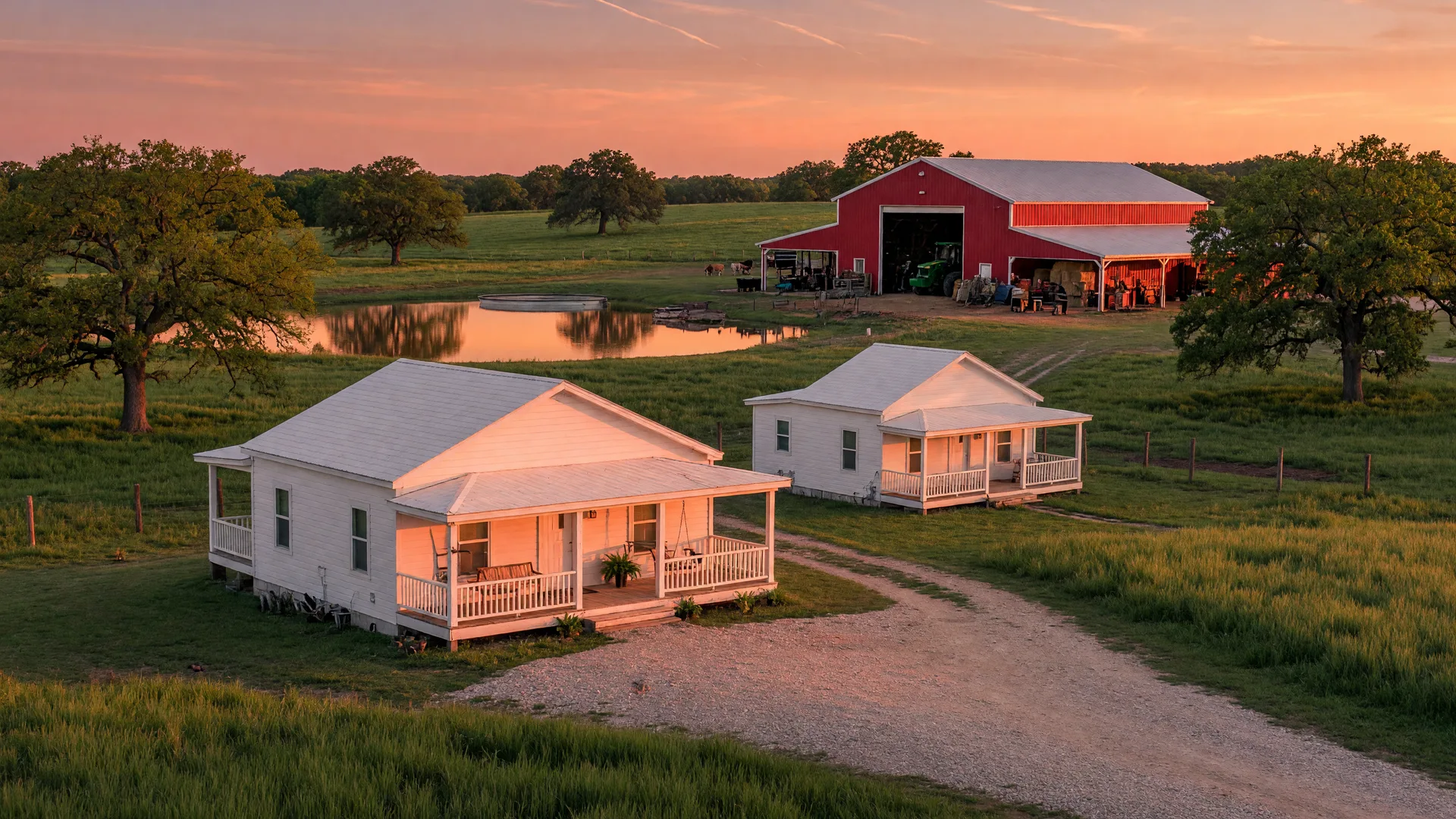
When a family decides to keep land for generations, the property has to do more than look good. It has to give more than one household room to live, work, and gather, often on the same tract. In Northeast Texas, that usually means a main home, a guest house or second dwelling, and working improvements like barns, shops, and fencing, all on acreage that can be passed down. This guide covers what to look for on the ground and what to verify with the county before you commit.
Shannon and Scott Miles hear the multigenerational question more every year, from couples building a place where parents can move in, to adult children who want to keep the family place in the family. As founding members of the eXp Land and Ranch division, they evaluate legacy properties across Northeast Texas every week. This is the framework they use.
What Makes a Property a Legacy Ranch?
A legacy ranch is not defined by acreage alone. It is a property laid out so a family can hold it for decades: separate living space for more than one generation, working improvements that support how the land is used, and water that is dependable year-round. Some families want a shared weekend retreat. Others want parents, adult children, and grandchildren each in their own home on one tract. Both start with the same questions.
Why Shared Family Land Is Growing
The move toward shared family land is not a short-term trend. The U.S. Census Bureau counted 6.0 million multigenerational households nationwide in 2020, up from 5.1 million in 2010, and Texas ranks among the states where they are most common. Caregiving, shared expenses, and the desire to stay close are the reasons families most often name. Rural acreage fits that goal naturally, because it gives every household its own building and its own space on one property. For the underlying data, see the Census Bureau’s overview of multigenerational households (census.gov).
The Property Features That Matter Most
Separate Dwellings and Guest Houses
A second home, guest house, or accessory dwelling is often the difference between a property that works for one family and one that works for two or three. Look at how the buildings sit in relation to each other, whether each has its own entry and parking, and whether the property has room to add another dwelling later. Existing guest quarters are worth a closer look; our guide to homes with guest houses walks through what to expect.
Water: Ponds, Creeks, and Wells
Dependable water supports livestock, irrigation, wildlife, and everyday living, and it is a leading driver of land value. Verify the source on the property, its quality and capacity, and how water rights convey with the land. Our answer on ponds and water sources covers the questions to ask on any rural tract.
Septic Capacity for More Than One Household
This is the biggest practical hurdle for a second dwelling on rural land. In Texas, on-site septic systems are permitted and sized by the number of bedrooms and living units, so adding a guest house typically means a new or expanded system. The Texas Commission on Environmental Quality regulates these systems (tceq.texas.gov), and the county’s environmental health office approves them. Confirm what the property can support before you fall in love with the house; our septic guide explains the basics every acreage buyer needs.
Access and Road Frontage
A tract that works for multiple households needs good, legal access, especially if a guest house sits toward the back of the property. Confirm a deeded right to use the drive, all-weather road condition, and who maintains a shared road. See how to evaluate road access and frontage before making an offer.
One Tract or Separate Parcels?
Decide whether the family wants one deeded tract or separate parcels. County subdivision rules, deed restrictions, and septic feasibility all shape what is possible, and dividing land after a purchase is not always straightforward. Our answer on whether you can subdivide land after you buy it explains how the rules vary by county.
Improvements: Barns, Shops, and Fencing
A sound shop, a good barn, and strong fences support the working side of a legacy property and can save a buyer years of building. Evaluate the structure, electrical service, and condition of every outbuilding. See how shops, barns, and improvements affect property value to gauge what is worth paying for.
What to Verify With the County Before You Buy
County rules vary, and a few phone calls before an offer save real headaches later. Start with three questions. What septic capacity does this property have, and can it support an additional dwelling? Does the planned layout require a subdivision plat? What permits apply to a well, a driveway, or a second home? Most unincorporated Texas counties do not require a residential building permit for single-family homes, but water, septic, and access are regulated everywhere. Confirm the answers with the county’s environmental health and road offices, and check for deed restrictions before you write an offer.
Taxes, Title, and the Pieces That Follow the Land
An agricultural or wildlife valuation can keep property taxes reasonable on a working ranch, but the status must be met and maintained, and it does not always transfer with the sale. Mineral rights, easements, and title history should be reviewed with local professionals, because these pieces follow the land for generations. Our guides to ag-exempt ranch properties and mineral rights in Texas cover both in detail.
A Region Built for Family Land
Northeast Texas has long been a destination for this kind of property. Large tracts remain attainable, water is more dependable than in much of the state, and the region sits within reach of DFW for families who want country land without leaving their careers behind. The counties around Paris, including Lamar, Fannin, Delta, Hopkins, and Red River, offer the mix of space, schools, and small-town services that make multigenerational living practical. Our guide to homes on acreage in Lamar County and the land and ranch page are good starting points, and relocating buyers can read more in our moving from DFW guide.
Start by Walking the Property
The best way to evaluate a legacy ranch is to walk it with someone who knows what to look for. Shannon and Scott Miles have helped families find, buy, and hold property across Northeast Texas for years, from working cattle ranches to multigenerational compounds. Call the Shannon Miles Group at (903) 785-2005, email hello@shannonmiles.com, or stop by the office at 2322 Lamar Ave. in Paris, TX, and let us help you find a place your family can call home for generations.

Shannon Miles Group
eXp Realty | Paris, TX
Shannon and Scott Miles are a husband-and-wife real estate team serving Northeast Texas and Southeast Oklahoma. They are founding members of the eXp Land and Ranch division and hold the GRI designation, and Shannon is a Certified Luxury Home Marketing Specialist (CLHMS). Based at 2322 Lamar Ave. in Paris, TX, they help families find premium acreage, legacy ranches, and multigenerational properties across eight Northeast Texas counties. To learn more about selling, see our selling land and acreage guide.