
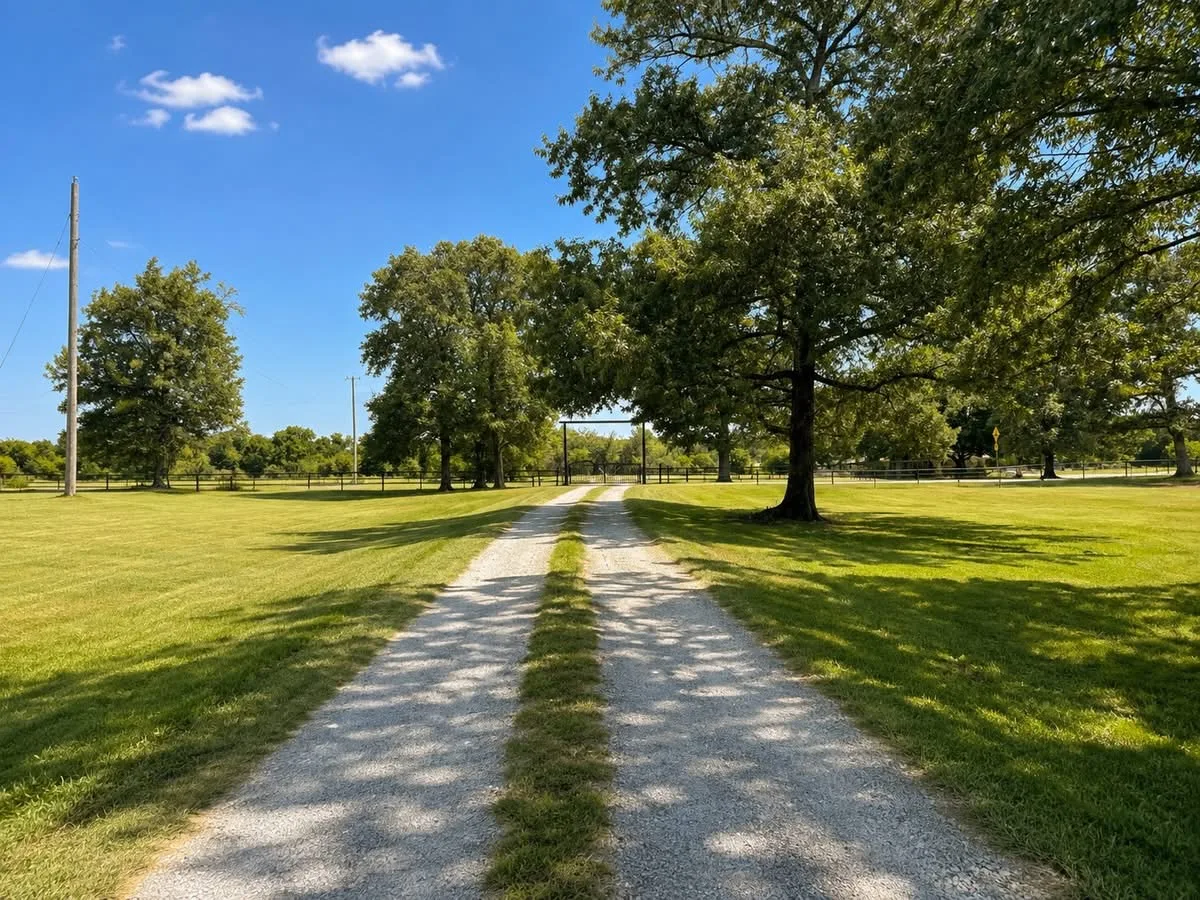
Who maintains the road to your rural property depends on what the road legally is, not on what it looks like. A county road is maintained by the county through the commissioners court and its road and bridge operation. A state highway or farm-to-market road is maintained by TxDOT. A private road or shared driveway is maintained by the property owners who use it, under the terms of a recorded easement or a private road maintenance agreement. The mistake buyers make is assuming the county takes care of everything, when a large share of rural access is private, and the maintenance obligation is written down in documents you should read before you close.
Road maintenance is one of those tract-level questions that feels simple until you are standing at the end of a gravel drive after a wet winter. Whether the road in front of your gate is a county road, a state highway, or a private easement changes who you call about a washout, who pays for gravel, and whether a lender will approve the loan. This guide walks through each situation in Northeast Texas, explains how the same question plays out in Southeast Oklahoma, and gives you a checklist to verify the answer for the exact tract you are considering.
It depends on the road's legal status. County roads in Texas are maintained by the county, not TxDOT: the commissioners court controls them, and work is handled through the four commissioner precincts or a road and bridge department. TxDOT maintains only the state highway network, including farm-to-market roads. Private roads and shared driveways are maintained by the owners who use them, and the recorded easement or a private road maintenance agreement sets out the terms. In Oklahoma, county roads are maintained by each county's Board of County Commissioners through three districts. On every tract, the way to know is to identify what the road is, then confirm who serves it. That is a due diligence step, not a guess.
The first question: what kind of road is it?
Every rural property has access of some kind, and the maintenance answer flows from the road's legal character. Three situations cover almost everything you will encounter in our market:
- A county road. A public road outside city limits that the county has laid out, opened, or accepted as part of its road system. The county maintains it, and it may be paved, gravel, or graded earth.
- A state highway or farm-to-market road. A road on the state's highway system. TxDOT owns and maintains it, and an entrance onto it requires a TxDOT access permit.
- A private road or shared driveway. A road owned and maintained by the property owners who have access rights over it, typically through an easement across one or more tracts. The county does not maintain it.
The same physical road can switch categories along its length, and a gravel road is not automatically a county road just because it looks public. If you are unsure, the survey, the title commitment, and the county road map settle it. Our answer on evaluating road access and frontage when buying land explains how legal access and physical access are two different things, and our guide to what road frontage means and why it matters covers the frontage side of the same question.
County roads in Texas: the county maintains them, not TxDOT
The most common misconception we hear is that the state takes care of every road. It does not. TxDOT maintains only the on-system state highway network: interstates, U.S. highways, state highways, and farm-to-market and ranch-to-market roads. The TxDOT county road criteria page is explicit that county roads are inventoried but maintained by the county, and the state does not maintain or fund routine county road maintenance.
For county roads, the authority rests with the county. Under Article 16, Section 24 of the Texas Constitution and Chapters 251, 252, 258, and 281 of the Texas Transportation Code, the commissioners court has general control over all county roads, highways, ferries, and bridges. Chapter 251 of the Transportation Code sets out that general county authority over roads and bridges, and Chapter 252 covers the systems of county road administration.
In practice, each of Texas's 254 counties is divided into four commissioner precincts, and each precinct elects one commissioner. Together the four commissioners and the county judge form the commissioners court. Most counties direct road and bridge work through the precinct system, meaning the commissioner for the precinct where the road sits oversees grading, gravel, drainage, and bridges in that precinct. Some counties run a county unit road system or a dedicated road and bridge department that does the work countywide. The Texas County Progress explainer on county road systems and their County Roads 101 overview are clear, plain-language places to start.
Finding the right county office for your tract
When a county road needs work, the practical step is to identify which precinct serves it and contact that commissioner's office or the county road and bridge department. County websites publish commissioner precinct maps and road department contacts, and the county judge's office can point you to the right person. This is also where the tract-level caveat lives: counties do not maintain every road to the same standard. Maintenance priority depends on the county budget, the road's classification, and its use, and a gravel county road may be graded on a schedule rather than on demand. Do not assume a county road is maintained like a city street.
If you are considering a specific property, the county offices that handle roads are part of the same local contact list we keep for our buyers. The helpful numbers page for Lamar County is one example of where those contacts live, and the full helpful numbers directory covers the other counties we serve in Northeast Texas and Southeast Oklahoma.
Driveway entrances, culverts, and gates in the right-of-way
Maintenance of the road itself is one thing; work in the road's right-of-way is another. In Texas, you generally need written approval from the county before installing a driveway entrance, culvert, or similar structure within a county road right-of-way, because the county has jurisdiction over its rights-of-way. Where the entrance meets a state highway, a TxDOT access driveway permit is required instead. Requirements, forms, and fees vary by county, so the reliable move is to contact the precinct commissioner's office, the county engineer, or the road department before any work begins. Our answer on whether you need a permit for a driveway entrance in Texas walks through this in detail.
Gates deserve their own mention because they are everywhere on rural property in this region. A gate cannot block a public county road or the access rights of others, and counties often have rules about gate placement and setback from the right-of-way. If the property you are looking at has a gate, verify its placement with the county and confirm it does not interfere with an easement serving another tract.
Private roads and shared driveways: the owners maintain them
A private road or shared driveway is maintained by the property owners who use it, not by the county or the city. This is the situation where most of the surprises hide, because the obligation is not written on a road sign; it is written in the easement. The recorded easement is the governing document. It should state who has the right to use the road, what the allowed uses are, and whether and how maintenance is shared. If the easement is silent, Texas has no general statute that assigns private road maintenance duties, so the document's terms control, and questions about who must maintain an easement are legal questions best run past a real estate attorney. The Texas A&M AgriLife Texas Ag Law discussion of easement maintenance explains the underlying rule and its limits.
For a shared road, the cleanest structure is a private road maintenance agreement, a recorded contract among the owners who use the road. It assigns each owner's share of grading, resurfacing, and drainage costs, sets the road standard, and explains what happens if an owner stops paying. Our full guide to buying a home on a private road covers maintenance responsibility, shared agreements, and emergency access in detail, and the answer on easements before buying land explains the access rights that sit underneath the whole arrangement.
Two related traps are worth naming. First, a tract can have physical access without legal access, which is exactly the situation our answer on landlocked property describes. Second, an informal agreement with a neighbor, even one that has worked for years, is not a recorded right and does not bind future owners. If access depends on an unrecorded arrangement, that is a title problem, not a small detail.
How lenders view private roads
The road also shows up in the loan process, and this is where a private road can quietly delay a closing. Fannie Mae generally requires a legally enforceable, recorded maintenance agreement or covenant for any property served by a private or community road, as set out in Section B4-1.3-04 of the Fannie Mae Selling Guide. USDA and FHA loans require a permanent recorded access right, and VA loans require a maintenance agreement or evidence that an association maintains the road. Because Texas does not statutorily assign private road maintenance duties, lenders financing a Texas property on a private road commonly ask for a recorded private road maintenance agreement before closing.
The practical takeaway is simple: ask your lender about the access requirements early, before you are under contract and racing a closing date. If a maintenance agreement is required and the road has several owners, the seller will need time to gather it. Checking this in the offer stage is part of the reason our acreage service starts with access and utility verification on every property we show.
Oklahoma: a three-district system with the same split
Across the Red River, the answer has the same shape with different offices. In Oklahoma, county roads are built and maintained by each county's Board of County Commissioners, which has jurisdiction over the designation, construction, maintenance, and repair of county highways and roads, funded through the county highway fund under Title 69, Section 601 and Section 622 of the Oklahoma Statutes. Each Oklahoma county is divided into three commissioner districts, not four, and each district elects one commissioner. A road maintenance request in Oklahoma goes through the district commissioner's office, and the OSU Extension county commissioners overview is a reliable primer on how those boards work.
Private roadways in Oklahoma are generally maintained by the abutting property owners. Oklahoma law references private roadways with minimum 2-acre lots and 50-foot easements that are not maintained by a county or city under Title 11, Section 47-119, and each county is divided into three commissioner districts under Title 19, Section 321. The exact treatment of a specific Southeast Oklahoma road depends on the county, so confirm the road's status and the serving district for the tract you are considering. Our guide to the differences between buying rural property in Texas and Oklahoma connects the road question to the rest of the border-state checklist.
What to verify on a specific tract
Road maintenance is a due diligence item, and it is one of the easiest to verify if you know what to ask for. Here is the checklist we walk with land buyers:
- Identify what the road is. Ask the seller and confirm with the county whether the access is a county road, a state highway, or a private road. The survey and title commitment should reflect the legal access.
- Read the access language. If access is by easement, read the recorded easement for the location, width, permitted uses, and any maintenance or cost-sharing terms. Ask your title company to pull it from the commitment.
- Confirm the serving office. For a county road, find the county website and commissioner precinct map, and note the precinct and road and bridge department that serves the road. Keep that contact with your property records.
- Check for a private road maintenance agreement. If the road is shared, confirm a maintenance agreement exists, is recorded, and covers the tract. Ask your lender whether a recorded agreement is required for the loan you are using.
- Verify the entrance permit status. If the property has a driveway or culvert in the right-of-way, confirm the county approval is on file, and plan for the permit process if you will create a new entrance.
- Ask about seasonal passability. A road that is fine in July can be a different story in February. Visit after heavy rain, and ask the seller and the county about wet weather access.
- In Oklahoma, adjust the office. Confirm the road is a county road and note which of the three commissioner districts serves it, or confirm it is a private roadway maintained by the abutting owners.
For the broader picture, the rural property section of the Answer Book keeps the full due diligence list in one place, and our Lamar County land and rural property guide ties the access question into the local market context.
The bottom line
Road maintenance responsibility comes down to the road's legal status, verified tract by tract. County roads in Texas are maintained by the county through the commissioners court and its precinct or road and bridge operations, while TxDOT handles only the state highway network. Private roads and shared driveways are maintained by the owners who use them, under the terms of a recorded easement or a private road maintenance agreement, and a lender may require that agreement before closing. In Oklahoma, county roads belong to the Board of County Commissioners through three districts, and private roadways fall to the abutting owners.
What we can do is help you identify what the road is, pull the access language from the title commitment, confirm the serving county office, and connect you with the right local contacts before you make an offer. That is part of the land and ranch service we provide across Northeast Texas, and it is why access is on the very first list we run on every rural showing. If you are weighing a property and want to know who really takes care of the road, call us at (903) 785-2005 or stop by the office at 2322 Lamar Ave. in Paris.
This guide draws on primary and institutional sources. Road maintenance authority is set by Texas and Oklahoma law and administered by local county offices, and specific roads, precincts, and policies change over time, so always confirm the serving authority for your exact tract with the county before relying on this information.
- TxDOT, County Road Criteria
- Texas Transportation Code, Chapter 251, General County Authority Relating to Roads and Bridges
- Texas Transportation Code, Chapter 252, Systems of County Road Administration
- Texas County Progress, Your Roads: Texas County Road Systems
- Texas County Progress, County Roads 101
- Texas A&M AgriLife Texas Ag Law, Who Is Required to Maintain an Easement?
- Fannie Mae Selling Guide, B4-1.3-04, Site Section of the Appraisal Report
- Oklahoma Statutes, Title 69, Section 601, Authority and Duties of County Commissioners
- Oklahoma Statutes, Title 69, Section 622, Duties of Counties to Maintain Roads
- Oklahoma Statutes, Title 11, Section 47-119, Use of Certain Private Roadways
- Oklahoma Statutes, Title 19, Section 321, County Commissioners' Districts
- OSU Extension, County Government Training Program: County Commissioners
Frequently Asked Questions
Who is responsible for maintaining a county road in Texas?
The county maintains its own county roads, not TxDOT. In Texas, the commissioners court has general control of county roads, highways, and bridges under the Texas Constitution and the Transportation Code. Each county is divided into four commissioner precincts, and road and bridge work is directed through the precinct system or a county road and bridge department. To reach the right office, contact your county website, the county judge's office, or the road and bridge department for the precinct that serves your road.
Does TxDOT maintain county roads in Texas?
No. TxDOT maintains only the on-system state highway network, which includes interstates, U.S. highways, state highways, and farm-to-market and ranch-to-market roads. County roads are maintained by the county. If your access is a county road, the county road and bridge operation is the one to call about maintenance, grading, or gravel.
Who maintains a private road or shared driveway on rural property?
A private road or shared driveway is maintained by the property owners who have access rights over it, not by the county or city. The recorded easement controls the obligation: its terms define who maintains, how costs are shared, and what happens if an owner stops paying. Texas has no general statute that assigns private road maintenance duties, so the easement language matters, and a real estate attorney is the right person to interpret it for a specific tract.
Do I need a private road maintenance agreement to get a loan on a private road?
Often, yes. Fannie Mae generally requires a legally enforceable, recorded maintenance agreement or covenant for a property accessed by a private or community road. USDA and FHA require a permanent recorded access right, and VA requires a maintenance agreement or evidence that an association maintains the road. Ask your lender early, because the requirement can change what paperwork the seller must produce before closing.
Do I need a permit to put in a driveway entrance or culvert on a county road?
Yes, in Texas you generally need written approval from the county before installing a driveway entrance or culvert within a county road right-of-way, and a TxDOT permit is required where the entrance meets a state highway. Requirements, forms, and fees vary by county, so contact the precinct commissioner's office, the county engineer, or the road department before doing any work in the right-of-way.
Who maintains county roads in Oklahoma?
In Oklahoma, county roads are built and maintained by each county's Board of County Commissioners, which has jurisdiction over county highways and roads and funds them through the county highway fund. Each Oklahoma county is divided into three commissioner districts, and a road request typically goes through the district commissioner's office. Private roadways are generally maintained by the abutting property owners.
Looking at rural land in Northeast Texas?
We will help you identify what the road is, pull the access language from the title commitment, and confirm the county office that serves your tract before you make an offer. Call (903) 785-2005 or send us a message.

Shannon Miles Group
eXp Realty | Paris, TX
Shannon and Scott Miles are a husband-and-wife real estate team serving Northeast Texas and Southeast Oklahoma. As founding members of the eXp Land and Ranch Division, they specialize in land, ranch, residential, commercial, and new construction across Lamar County and beyond.