
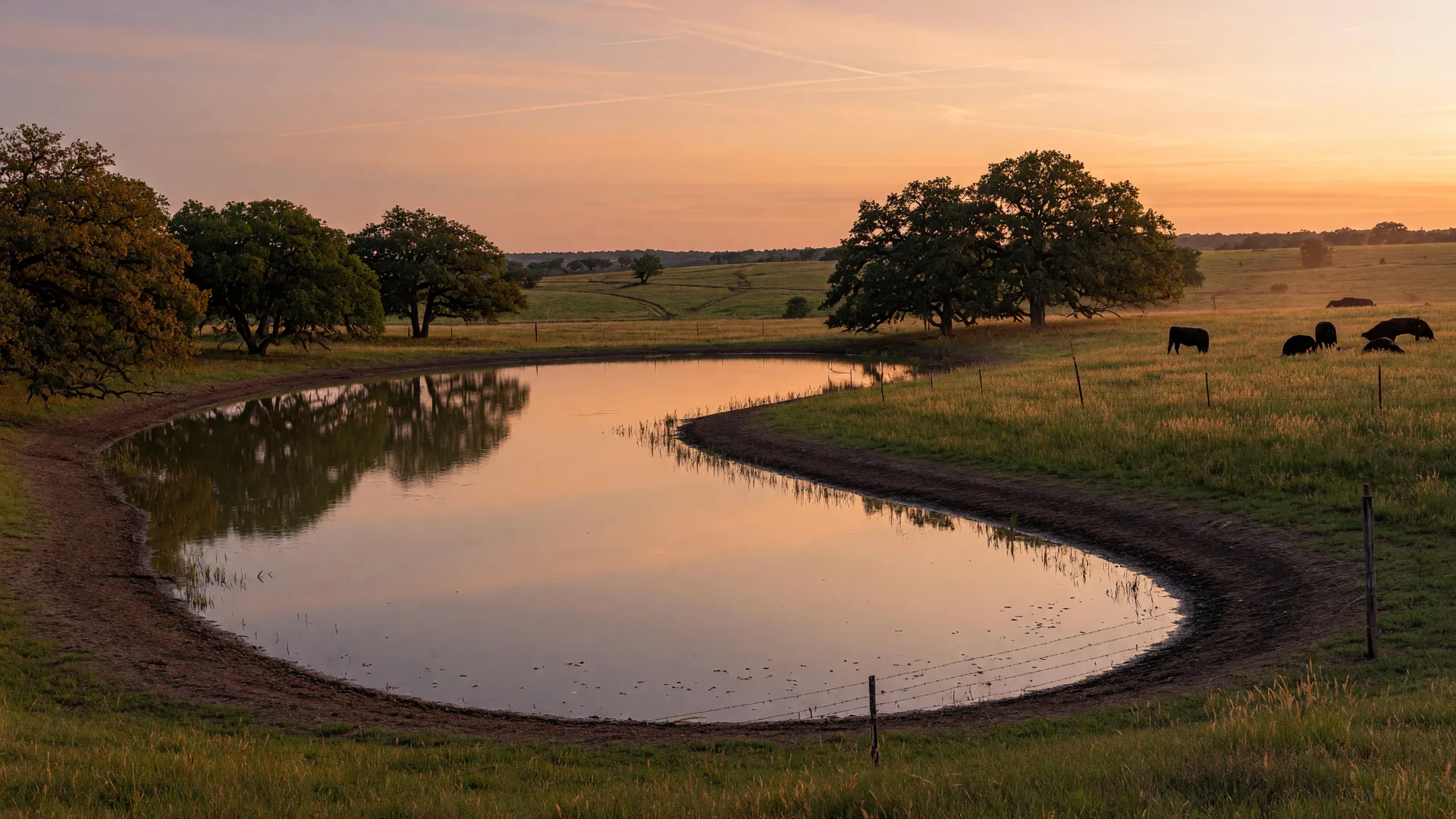
For most farm ponds and stock tanks, no, you do not need a water-rights permit, because Texas Water Code Section 11.142 exempts a pond or reservoir with normal storage of not more than 200 acre-feet on your own land when it is built for domestic and livestock purposes. That exemption also covers fish and wildlife uses on qualified open-space land in unincorporated areas. But "no water-rights permit" is not the same as "no rules at all": dam safety thresholds, federal wetland rules, county floodplain rules, and a call to Texas 811 can all apply to a specific tract before the first bucket of dirt moves. The answer changes by county, by site, and by state, so here is how it works in Texas and what changes in Oklahoma.
A pond is one of the first things many land buyers imagine, a stock tank for cattle, a fishing hole for the kids, or a water source that makes a tract usable. It is also one of the least understood items in rural due diligence, because the permitting question splits into several separate layers: state water rights, dam safety, federal wetlands, county floodplain rules, and utility safety. This guide walks each layer in plain language so you know which questions to ask before you buy the land or dig the hole.
In Texas, a pond or stock tank on your own land with normal storage of not more than 200 acre-feet generally needs no water-rights permit when it is used for domestic and livestock purposes, and a similar exemption covers fish and wildlife uses on qualified open-space land in an unincorporated area. Two hundred acre-feet is roughly 65 million gallons, while a typical one-acre, 8-foot-deep stock pond holds about 8 acre-feet, so most ponds sit far below the line. Commercial uses, ponds that impound from a navigable stream, and dams that cross the dam safety thresholds in 30 TAC Chapter 299 are different matters. A pond built in a stream or wetland may need a US Army Corps of Engineers Section 404 permit, a pond in a mapped floodplain may need a county floodplain development permit, and Texas law requires a call to 811 before any digging. In Oklahoma, the Oklahoma Water Resources Board requires a dam safety permit for dams more than 25 feet high, dams with more than 50 acre-feet of storage, or high-hazard dams. Every tract gets verified, never assumed.
Why the pond question comes up on every land deal
The pond question is really several questions wearing one hat. A buyer looking at a tract with an existing pond wants to know what they are inheriting: how full it stays, who built the dam, whether it is permitted, and what maintenance it needs. Our answer on buying land with a pond covers that side of the ledger, including dam condition, water source, and liability. A buyer planning to build a new pond on raw land faces a different set of questions: can this site hold water, and which permits apply before the equipment shows up. That forward-looking question is what this guide answers.
On a ranch, the pond is often the difference between usable and unusable pasture, which is why water shows up in almost every ranch evaluation. Our guide to ponds and water sources on ranch property explains how buyers judge whether a pond will actually serve cattle through a dry summer. When you plan to build that water source yourself, the regulatory layers below are what stand between you and the first cut of dirt.
Texas: the 200 acre-foot rule in Water Code Section 11.142
The starting point in Texas is Texas Water Code Section 11.142. It exempts a person who constructs on their own property a dam or reservoir with normal storage of not more than 200 acre-feet for domestic and livestock purposes from the water-rights permit that would otherwise be required. Even if the pond temporarily holds more than 200 acre-feet, no permit is needed if the owner can show the storage exceeded that amount on no more than one occasion in the preceding 12 months.
A second exemption in the same section covers a dam or reservoir with normal storage of not more than 200 acre-feet used for fish and wildlife purposes, including fishing but not fish farming, on qualified open-space land in an unincorporated area. That is the rule that lets landowners build a recreational fishing pond without chasing a state water-rights permit.
Here is the context that keeps most landowners calm: 200 acre-feet is about 65 million gallons, while a typical one-acre, 8-foot-deep stock tank holds roughly 8 acre-feet. The exemption is generous for ordinary farm and ranch use. But it has real edges. The pond must sit on land you own, it must be used for the allowed purposes, and it generally must not impound water from a navigable stream. Commercial operations are not exempt: water impounded for resale, commercial irrigation, mining, or other commercial use still requires a permit. The Texas A&M AgriLife Extension publication "A Pond to Call My Own: Understanding Water Law in Texas" walks through the ownership side and the exemption limits in plain language, and it is worth reading before you size a pond for a plan that is bigger than a stock tank.
When a pond dam needs a dam safety review
Water rights and dam safety are separate questions, and a common mistake is treating them as one. In Texas, the TCEQ Dam Safety Program administers dam safety under Water Code Section 12.052 and the rules in 30 TAC Chapter 299. A pond dam can require TCEQ review and approval of plans and specifications when it:
- Reaches 25 feet or more in height with a maximum storage capacity of 15 acre-feet or more.
- Stands more than 6 feet high with a storage capacity of 50 acre-feet or more.
- Is a high- or significant-hazard dam more than 6 feet high, regardless of storage size.
- Is a pumped-storage or terminal-storage facility.
Many farm ponds never approach those numbers, and the rules include an important exemption for private property. Under Water Code Section 12.052(e-1), a dam on private property that impounds less than 500 acre-feet, is a low- or significant-hazard dam, sits in a county with a population under 350,000, and lies outside a city limit is exempt from the dam safety rules. Almost every county in the region we serve meets the population test, which is why a typical Northeast Texas stock tank clears this layer. Still, hazard classification depends on what is downstream, so a dam above a home or a road can change the picture even when it is small. Confirm with TCEQ for your exact dam rather than assuming the exemption.
One agency note worth repeating because it surprises buyers: the Texas Water Development Board funds and helps maintain dams, but TCEQ, not TWDB, issues the dam safety reviews. If you hear "dam safety" in Texas, the TCEQ Dam Safety Program is the office to call.
Ponds in streams and wetlands: the federal question
The third layer is federal, and it matters most when a pond is planned in or near a creek, stream, or wetland. Under the Clean Water Act, the US Army Corps of Engineers Section 404 program requires a permit before discharging dredged or fill material into waters of the United States, including wetlands. The rock, sand, and dirt used to build an impoundment in a jurisdictional stream or wetland is exactly the kind of discharge the program regulates.
There is a widely cited exemption for the construction and maintenance of farm and stock ponds under Section 404(f)(1), but it is not automatic. The exemption can be lost under Section 404(f)(2) if the discharge is part of an activity that brings the area into a new use or otherwise changes the reach or flow of the water. A pond built in a creek bed, a wetland, or an area that drains a jurisdictional water can land squarely in the Corps' jurisdiction. The reliable move is to ask the Corps for a jurisdictional determination, sometimes called a wetland delineation, before you commit to a site. Our answer on creeks, springs, and seasonal water on a farm or ranch is a good place to understand why wet areas matter before you build.
Call Texas 811 before a single bucket moves
One step is not optional, and it is often the cheapest insurance in the whole project. Texas law under Utilities Code Chapter 251 requires anyone excavating with mechanized equipment to contact Texas 811 at least two business days before digging, even on your own land. The utility companies mark buried gas, electric, phone, water, and sewer lines so your dozer does not find them the expensive way. The call is free, and it produces a ticket number you keep. The Texas Farm Bureau explains why 811 is a legal requirement, not a courtesy, and every contractor we work with treats the ticket as step one.
The same habit belongs in your buying checklist, because a pond site that sits over a buried line is a bad surprise to discover after closing. When you are weighing a tract, ask whether utility easements or buried lines cross the area you would use for a pond. Our guide to pipelines and utility easements crossing a property explains how to read what the maps and the ground tell you.
County floodplain and drainage rules
County rules form the last local layer. If the proposed pond site sits in a mapped floodplain, the county floodplain administrator may require a floodplain development permit before excavation, and the FEMA flood map is the starting point for that conversation. Drainage is the other half: a pond that blocks or redirects a drainageway can affect a neighbor's land, and some counties regulate that. Our answer on floodplains before buying land explains how to read the maps and when a map does not tell the whole story, and our guide to checking topography and drainage before buying shows why a wet corner on the map is not the same as a workable pond site.
Two free resources belong on your list before you design anything. The local NRCS field office uses Conservation Practice Standard 378 for ponds, which covers site investigations, watershed size, and design, and the NRCS and your county soil and water conservation district can offer free technical assistance on siting and soils. The local Texas A&M AgriLife Extension county agent is the other call, and the AgriLife fisheries program has a practical pond construction guide for landowners. Both agencies are used to answering these exact questions for Northeast Texas tracts.
Where a new pond should not go
Siting mistakes are the most common reason a well-intentioned pond becomes a problem, and the same list applies whether you are building a stock tank, a fishing pond, or a wildlife water. A few rules of thumb keep a pond on the right side of every layer above:
- Stay away from septic systems. Keep the pond well clear of the septic tank and drain field, typically at least 50 to 100 feet. Pond water can saturate a drain field, and a failing system can contaminate the pond.
- Respect the well setback. Texas sets a 50-foot minimum between a well and a septic system, and a pond should sit clear of both so surface water never runs toward your water supply.
- Keep clear of buildings. A pond near a home or shop can threaten foundations and invite moisture problems. Give structures a generous buffer.
- Avoid buried lines. Even with an 811 locate, avoid building a pond directly over buried gas, water, sewer, or electrical lines.
- Do not dam a watercourse casually. Building in a stream bed raises the federal and water-rights questions at once. A pond that captures off-channel runoff is a far simpler project than a dam across a creek.
- Think about overflow. Position the spillway so overflow drains away from the home, the shop, and the road, never toward them.
These are the same siting questions that determine whether a tract can support a pond at all, which is why they belong in your pre-offer due diligence. Our answer on how to tell if land is buildable ties water, septic, and drainage into the full buildability checklist, and our guide to how much of an acreage tract is actually usable shows how a wet corner or a steep slope shrinks the usable acreage before you ever dig.
Oklahoma: different thresholds, same verification habit
If you are looking at acreage in Southeast Oklahoma, the state layer changes even though the habit does not. In Oklahoma, the Oklahoma Water Resources Board requires a dam safety permit before constructing, enlarging, altering, or repairing a dam that:
- Is more than 25 feet in height measured from the natural stream channel or bed to the top of the dam.
- Has a storage capacity of more than 50 acre-feet at maximum storage elevation.
- Is classified as high hazard, meaning failure would risk probable loss of human life, regardless of size.
Below those thresholds, small farm ponds and stock tanks generally do not require an OWRB dam safety permit, and Oklahoma law recognizes an agriculture-exempt dam: a low-hazard dam less than 25 feet high with normal storage of less than 100 acre-feet used primarily for agriculture, for which no permit is required. Farm ponds and gully plugs that are not on definite streams and are built under the supervision and specifications of a local soil and water conservation district are exempt from Oklahoma's water-appropriation permitting, because capturing diffused surface runoff off the channel is generally unregulated.
The caveats in Oklahoma mirror the Texas ones. A pond in a floodplain can draw an OWRB floodplain-management review, a pond in waters of the United States or wetlands can draw a Corps Section 404 permit, and a pond that dams a definite stream and uses the water can require a stream-water-use, or appropriation, permit. The OSU Extension publication on environmental regulatory compliance for farmers and ranchers in Oklahoma is a reliable plain-language walkthrough, and the OWRB Dam Safety program is the office to confirm thresholds for a specific site. Our guides on what Texas buyers should know before buying land in Oklahoma and the differences between buying rural property in Texas and Oklahoma cover the other ways the two states diverge for rural buyers.
What to check before you buy
Pond permitting is a due diligence item, not a surprise you want after closing. Here is the checklist we walk with land buyers, whether they are buying a pond that already exists or planning to build one:
- Ask what the seller knows. If a pond already exists, ask about its construction, any permits on file, the water source, and how it performed in the last drought. Our answer on buying land with a pond gives the full list of questions.
- Check the flood map. Is the pond site or the buildable area in a mapped floodplain? Ask the county floodplain administrator whether a development permit would be required.
- Confirm the dam class. For a dam that exists or is planned, confirm the height and storage against the TCEQ thresholds and the private-property exemption before you commit.
- Ask about streams and wetlands. If a creek, seasonal water, or wetland crosses the tract, the Corps may hold jurisdiction. Our guide to creeks, springs, and seasonal water on a farm or ranch explains why that matters.
- Plan the siting. Confirm there is a spot for a pond that stays clear of the septic drain field, the well, buried lines, and buildings, and where overflow drains away from structures.
- Budget the build. Pond construction is a real cost that varies with soil, watershed, and size. Get a property-specific quote from a local excavation contractor and, if the NRCS is involved, ask about cost-share through the environmental quality incentives program.
Most of this is simple to check, it just has to be checked, and most of it is free to verify with the county and the state. If you are weighing the whole water and utility picture on a tract, the wells, septic, and utilities section of the Answer Book is the best place to keep going, and the companion pieces in this series on whether you need a well permit in Lamar County and whether you need a septic permit in Lamar County pair naturally with the pond question.
The bottom line
For a typical farm pond or stock tank in Texas, the answer is reassuring: under Texas Water Code Section 11.142, a pond on your own land with normal storage of not more than 200 acre-feet, built for domestic and livestock use or for fish and wildlife on qualified open-space land, generally needs no water-rights permit. But the permit question never lives alone. Dam safety thresholds in 30 TAC Chapter 299, the private-property exemption under Section 12.052(e-1), federal Section 404 rules for streams and wetlands, county floodplain rules, and a mandatory Texas 811 call all sit on top of the water-rights layer. In Oklahoma, the OWRB dam safety thresholds and the agriculture-exempt dam rule set the line, with the same federal and floodplain caveats. Every layer has to be verified for the exact tract, because no two sites are the same.
What we can do is help you identify the county floodplain administrator and the serving agencies for the tract you are considering, connect you with the local NRCS field office and AgriLife Extension for free technical help, and walk the water picture with you before you make an offer. That is part of the acreage service we provide across Northeast Texas, and it is why the water question is on every land showing we do. For the full land buyer's checklist in one place, the Lamar County land and rural property guide and our land and ranch service page are good places to start.
This guide draws on primary and institutional sources. Pond and dam rules are set by state law and administered by state and federal agencies and local authorities, and they change over time, so always confirm the current requirements for your exact tract with the permitting authority before you build.
- Texas Water Code Section 11.142, Permit Exemptions
- Texas A&M AgriLife Extension, "A Pond to Call My Own: Understanding Water Law in Texas"
- Texas Commission on Environmental Quality, Dam Safety Program
- 30 TAC Chapter 299, Dam Safety Applicability
- Texas Water Code Section 12.052, Dam Safety
- US Army Corps of Engineers, Section 404 of the Clean Water Act
- Texas 811, Call Before You Dig
- USDA NRCS, Conservation Practice Standard 378 (Pond)
- Oklahoma Water Resources Board, Apply for a Permit to Construct or Modify a Dam
- Oklahoma Statutes Section 82-110.4, Dams Subject to Regulation
- OSU Extension, Environmental Regulatory Compliance for Farmers and Ranchers in Oklahoma
Frequently Asked Questions
Do I need a permit to build a pond or stock tank on my land in Texas?
For a typical farm pond or stock tank on your own land, no water-rights permit is required under Texas Water Code Section 11.142 when the pond has normal storage of not more than 200 acre-feet and is built for domestic and livestock purposes, or for fish and wildlife purposes on qualified open-space land in an unincorporated area. Commercial uses are not exempt. No permit does not mean no rules: dam safety thresholds, federal wetland rules, county floodplain rules, and a Texas 811 call can all still apply to the specific tract.
How big can a pond be without a water-rights permit in Texas?
Under Texas Water Code Section 11.142, a pond or reservoir with normal storage of not more than 200 acre-feet can be exempt. Two hundred acre-feet is roughly 65 million gallons, while a typical one-acre, 8-foot-deep stock pond holds only about 8 acre-feet. The pond must sit on land you own, be used for the allowed purposes, and generally must not impound water from a navigable stream.
When does a pond dam require a dam safety permit in Texas?
TCEQ administers dam safety under Water Code Section 12.052 and 30 TAC Chapter 299. A dam can require review and approval of plans when it is 25 feet or more high with at least 15 acre-feet of storage, more than 6 feet high with at least 50 acre-feet of storage, or a high- or significant-hazard dam more than 6 feet high. Many farm ponds fall under the private-property exemption for dams impounding less than 500 acre-feet in a county under 350,000 population outside city limits.
Do I need a US Army Corps of Engineers permit to build a pond?
If the pond is built in a stream or wetland that counts as waters of the United States, a Section 404 permit is generally required before discharging dredged or fill material to build the impoundment. There is an exemption for farm and stock ponds under Section 404(f)(1), but it can be lost if the work brings the area into a new use or changes the reach or flow of the water. Verify jurisdiction with the Corps before you dig.
Does Oklahoma require a permit to build a pond?
In Oklahoma, the Oklahoma Water Resources Board requires a dam safety permit before constructing a dam more than 25 feet high, a dam with more than 50 acre-feet of storage, or a high-hazard dam regardless of size. Small farm ponds below those thresholds generally need no OWRB dam safety permit, and agriculture-exempt dams under 25 feet with less than 100 acre-feet of normal storage are exempt. A pond that dams a definite stream may need a water-use permit.
Planning a pond on rural land in Northeast Texas?
We will help you identify the county floodplain administrator, connect you with the local NRCS field office and AgriLife Extension, and walk the water picture before you make an offer. Call (903) 785-2005 or send us a message.

Shannon Miles Group
eXp Realty | Paris, TX
Shannon and Scott Miles are a husband-and-wife real estate team serving Northeast Texas and Southeast Oklahoma. As founding members of the eXp Land and Ranch Division, they specialize in land, ranch, residential, commercial, and new construction across Lamar County and beyond.