
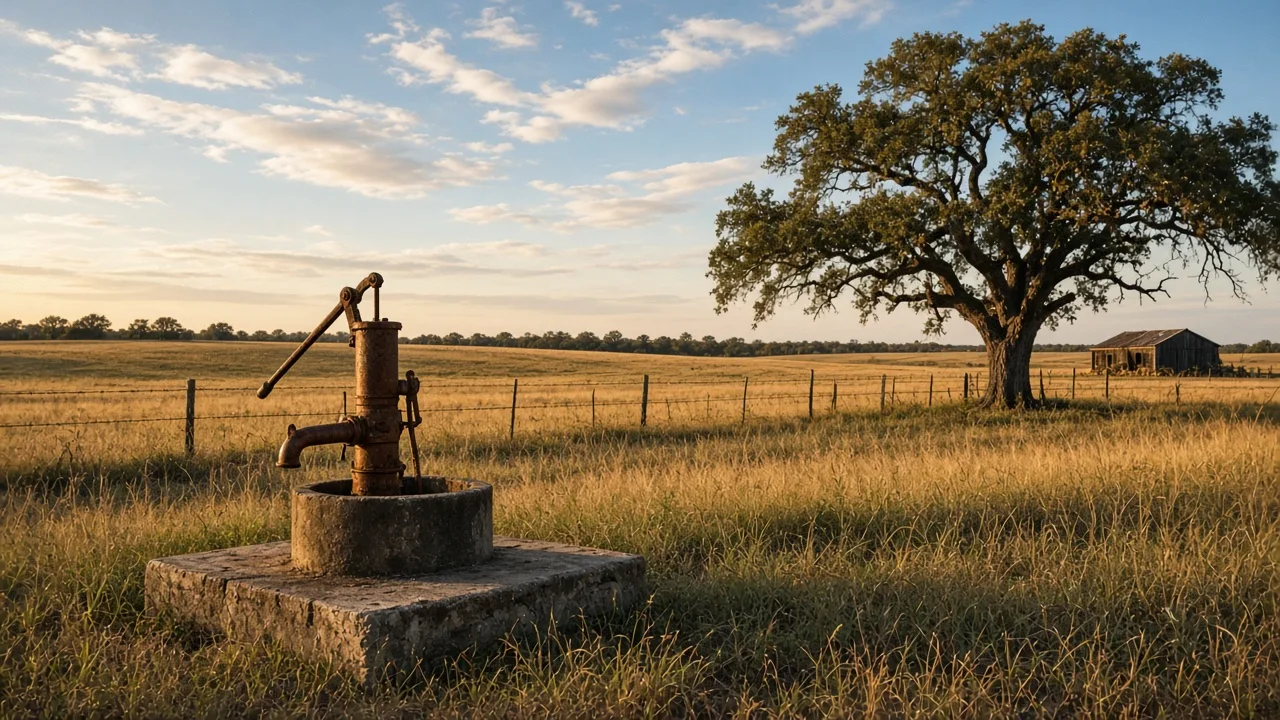
You find an abandoned well the same way you find most surprises on rural land: you look for it before you close, not after. That means walking the property for old casings, pipes, and windmill bases, asking the seller directly about the well history, and searching the two big state well records, the TCEQ Water Well Report Viewer for older driller reports and the TWDB/TDLR Submitted Drillers Report database for wells reported since 2001. If you find one, treat it as a real due diligence item, because in Texas the landowner of record is the one responsible for plugging it.
Abandoned wells are the quiet cousin of the septic question, the thing nobody talks about at the showing because it sits under the grass. An old windmill base at the edge of a field, a rusted pipe behind the barn, a concrete pad nobody can explain, each one can be the top of a well that was never properly closed. On Northeast Texas acreage, some of these are a century old, and the paper trail can be thin. Here is how to find them, what the law says, and what changes between Texas and Oklahoma.
Yes, there can be an abandoned well on the land you are considering, and the way to find out is a combination of boots-on-the-ground work and state records. Walk every corner of the property looking for well casings, pipes, windmill towers or bases, cement pads, and old pump houses. Ask the seller for the property's full well history, and ask neighbors who have been there a while. Then search the TCEQ Water Well Report Viewer for older scanned driller reports and the TWDB/TDLR Submitted Drillers Report database for wells reported since 2001. In Texas, the landowner of record is responsible for plugging an abandoned or deteriorated well, so identify, evaluate, and resolve any find before you close. Every tract gets verified, never assumed.
Why an abandoned well matters on rural land
An unplugged well is an open hole into the groundwater, and that is the problem in one sentence. It is a physical hazard for people, livestock, and equipment, a rusty casing can give way underfoot, and it is a direct channel for surface water, fertilizer, and other contaminants to reach the aquifer below. Because every rural water supply in the area depends on that same groundwater, an abandoned well is not just a personal nuisance, it is a neighborhood concern.
The other reason it matters is legal. In Texas, an abandoned or deteriorated well is the responsibility of the landowner of record, and the state can hold that owner liable for injury or pollution the well causes. When you buy the land, you become the landowner of record. So an abandoned well discovered after closing, one nobody disclosed and the contract did not address, is a problem you just inherited. That is why the search belongs before the offer, not after the closing. If you are also weighing the water side of the property, our guide to buying a property with a private well explains what to ask for on an active well, and the companion question of whether you need a permit to drill a new well in Lamar County covers the other end of the well lifecycle.
What counts as an abandoned well in Texas
Texas defines an abandoned well in its water well rules, and the definition is broader than a collapsed hole. Under the Texas Department of Licensing and Regulation guidance on abandoned or deteriorated water wells, a well is abandoned when it is no longer in use, unless the casing, pump, and pump column are in good condition and the well is properly capped. A deteriorated well is one that is causing, or likely to cause, pollution. Both are regulated.
- Abandoned. Not in use, and not maintained to a standard that keeps it safe and sealed. An old windmill that still has its tower but a rusted-out casing below is a classic example.
- Deteriorated. Causing or likely to cause pollution, whether or not anyone still uses it. This is the category that makes an old well a water-quality risk to everything around it.
- Capped versus plugged. A properly capped well is sealed at the top and still counts as in use for a non-deteriorated well. A plugged well is filled and permanently closed.
The practical point for a buyer is that any well you are not planning to use, and any well that is not in good repair, is a potential liability the moment you own the land. The Texas Commission on Environmental Quality landowner's guide to plugging abandoned water wells is the plain-language document that explains the whole framework, and it is worth reading before you walk a property.
Step one: walk the land and read the clues
The best tool for finding an old well is still your own eyes, and you want to look before the grass is mowed flat. Wellheads and casings can hide in tall grass, brush lines, and tree lines, so walk the property methodically rather than just touring the house.
- Look for casings and pipes. A steel or PVC pipe sticking up a few inches or a foot out of the ground, sometimes with a cap, is the most direct sign. Rusted pipe with no clear purpose deserves a closer look.
- Look for windmill towers and bases. Even when the tower is gone, a concrete or wooden base, or a rusted pump rod, marks a former well site. Old windmills were the standard water source on these farms.
- Look for cement pads and pump houses. A small concrete pad in an odd place, or the footprint of an old pump house, often sits over a well that may or may not still be active.
- Watch low spots and fence corners. Wells were often placed near where water was needed, which means near corrals, gardens, tank pens, and the corners of fields.
Anything you cannot identify, ask about. The seller, the neighbors, and the people who have worked the land usually know the story, and their memory is often the only record that exists for a 1930s windmill. If you are building or improving the land, our answer on how to tell if land is buildable ties the well question into the rest of the site-readiness checklist.
Step two: search the state well records
Texas keeps two major sets of water well records, and both are searchable by the public. They are not a complete census of every well ever drilled, especially for very old hand-dug wells, but they are the best paper trail the state has.
- TCEQ Water Well Report Viewer. This is a map-based locator of more than 800,000 scanned historical driller reports, largely for wells drilled before 2003. If there is an old well on the tract, this is where its report is most likely to surface. The viewer is at tceq.texas.gov/gis/waterwellview.html.
- TWDB/TDLR Submitted Drillers Report database. Since 2001, driller reports are submitted electronically, and they live in the Submitted Drillers Report, or SDR, database, which holds hundreds of thousands of well reports and plugging reports. The Texas Water Development Board explains how to use it on its groundwater data and well reports page.
- The county appraisal district. The TWDB's own guidance on locating a water well report recommends pulling the deed history from the county appraisal district and using prior owners' names, well depths, and drill dates to narrow the search. That paper trail is a powerful complement to the state databases.
In a county that sits inside a groundwater conservation district, add one more stop: the district itself. Districts keep their own well registration and drilling records, and they are the local experts on what is documented in their boundaries. In Fannin and Grayson Counties, that is the Red River Groundwater Conservation District. Lamar County sits outside a groundwater district, so the state databases and the appraisal district are the main records there.
What Texas law requires once a well is abandoned
Texas law gives the landowner a specific job and a specific timeline. When a landowner learns that a well on their property is abandoned or deteriorated, the state expects it to be plugged or properly capped within 180 days, under standards adopted by the state. The rules sit in Texas Water Code Chapter 32 and the TDLR water well rules, and the Texas Groundwater Protection Committee water well pages pull the pieces together in one place.
- Who plugs it. Plugging is normally done by a licensed water well driller or pump installer, who follows the state-adopted plugging standards. A landowner can plug their own well in some cases by following the same standards, but the licensed route is the safe, documented one.
- How it is plugged. The well is filled from bottom to top with cement, bentonite chips, or bentonite grout. Where bentonite is used, the top is finished with a cement cap at least two feet thick.
- What gets filed. Within 30 days of plugging, a State of Texas Plugging Report must be filed with TDLR. That report is the record that the well is closed, and it matters for the next buyer of the property.
The 2023 change to Texas law matters for buyers in district counties too. Senate Bill 279 gave groundwater conservation districts explicit enforcement authority over abandoned wells, which means a district can be the agency that flags and pursues an unplugged well. That is another reason to check with the district when you are buying land inside one. Our guide to whether you own the water under your land in Texas explains the ownership side of the water question, and the wells, septic, and utilities section of the Answer Book is the best place to keep going on the full water picture.
Oklahoma: the OWRB is the plugging authority
If you are looking at acreage in Southeast Oklahoma, the well plugging rules are different again, and the authority is the Oklahoma Water Resources Board. The rules live in Oklahoma Administrative Code Title 785, Chapter 35, and the Board's fact sheet on plugging abandoned wells walks through the requirements.
- Who is responsible. If a well is abandoned while the drilling equipment is still on site, the driller is responsible for plugging it. If a well is abandoned after the equipment has been removed, the landowner of the property is responsible.
- Who does the work. Plugging must be performed by an OWRB-licensed well driller, and the driller files a completion report with the Board after the work is done.
- How it is done. An uncontaminated well is filled with compacted drill cuttings and suitable fill material, then finished with cement grout near the surface and clean, compacted native soil in the top few feet, so surface water and poor-quality water cannot flow down the casing.
The same search steps apply in Oklahoma: walk the land, ask the seller, and check the state records for a completion report on any well on the tract. The OWRB keeps the well logs and completion reports for the wells it licenses, and a licensed driller can help you interpret what the records show. Our guides on what Texas buyers should know before buying land in Oklahoma and the differences between buying rural property in Texas and Oklahoma cover the rest of the border-state picture.
What to check before you buy
Abandoned wells are a due diligence item, and like septic and road access, they are much cheaper to investigate before closing than after. Here is the checklist we walk with land buyers:
- Walk the whole property. Do not limit the search to the house site. Check tree lines, fence corners, corrals, tank pens, and any spot where water would have been needed.
- Ask the seller and the neighbors. Get the property's well history in writing if you can. Ask how many wells were ever on the tract, which are still in use, and which were closed, and when.
- Search the state records. Run the tract through the TCEQ Water Well Report Viewer and the TWDB/TDLR SDR database, and pull the deed history from the county appraisal district to guide the search.
- Check with the local groundwater district. In a district county, ask the district for its well records and for any enforcement action on the tract.
- Get an evaluation by a licensed driller. A licensed water well professional can inspect a suspect casing, tell you whether a well is active, abandoned, or deteriorated, and quote what proper plugging would cost. That estimate belongs in your negotiation.
- Address it in the contract. If an abandoned well exists, decide who plugs it and when, and put it in writing. An undisclosed well that is the seller's responsibility is far easier to resolve before closing than after.
If the property has an active well, the same licensed professional can run the water quality and flow tests you need. Our answer on well water testing before buying and our guide to what to have inspected on a private well cover the active-well side, and what it costs to drill a well in Northeast Texas gives you the frame for comparing a new well against repairing an old one.
The bottom line
An abandoned well is findable, and the finding is the first step. Walk the land for casings, windmill bases, and pipes, ask the seller for the well history, and search the TCEQ Water Well Report Viewer and the TWDB/TDLR driller report database, then check with the local groundwater district where one exists. In Texas, the landowner of record is responsible for plugging an abandoned or deteriorated well, so any find belongs in your due diligence and your contract before you close. In Oklahoma, the OWRB oversees the same responsibility, and plugging must be done by a licensed driller.
What we can do is help you build the water question into every showing, connect you with licensed local well professionals for an evaluation and plugging estimate, and make sure an old well is addressed in writing before you commit. That is part of the acreage service we provide across Northeast Texas, and it is why the water story is on every land walk we do. For the full land buyer's checklist in one place, the Lamar County land and rural property guide and our land and ranch service page are good places to start.
This guide draws on primary and institutional sources. Abandoned well rules are set by state law and administered by state agencies and local groundwater districts, and they change over time, so always confirm the current requirements for your exact tract with the responsible agency before you buy or plug.
- Texas Department of Licensing and Regulation, Abandoned or Deteriorated Water Wells
- Texas Commission on Environmental Quality, Landowner's Guide to Plugging Abandoned Water Wells
- Texas Water Development Board, Groundwater Data and Well Reports
- Texas Water Development Board, Locating a Water Well Report
- Texas Commission on Environmental Quality, Water Well Report Viewer
- Texas Groundwater Protection Committee, Water Wells
- Red River Groundwater Conservation District
- Oklahoma Water Resources Board, Plugging Abandoned Wells
- Oklahoma Water Resources Board, Wells and Licensing
Frequently Asked Questions
How do I find out if there is an abandoned well on a rural property in Texas?
Walk the property looking for casings, pipes, windmill bases, and old pump houses, ask the seller about the well history, and search the TCEQ Water Well Report Viewer for older driller reports and the TWDB/TDLR Submitted Drillers Report database for wells reported since 2001. In a county inside a groundwater conservation district, ask the district too, because it keeps its own well records.
Who is responsible for plugging an abandoned well in Texas?
The landowner of record is responsible for plugging an abandoned or deteriorated well and can be liable for injury or pollution from it. Texas law gives the landowner 180 days to plug or cap a well after learning it is abandoned or deteriorated, and a State of Texas Plugging Report must be filed with TDLR within 30 days of plugging.
Can a landowner plug a well themselves in Texas?
Yes, in some cases, by following the state-adopted plugging standards, which generally means filling the well from bottom to top with cement, bentonite chips, or bentonite grout, with a cement cap at least two feet thick for bentonite plugs. Because the details depend on the well and the rules, it is wise to have a licensed water well driller or pump installer do the work.
What are the abandoned well rules in Oklahoma?
The Oklahoma Water Resources Board regulates well plugging. If a well is abandoned while drilling equipment is still on site, the driller is responsible for plugging it. If it is abandoned after the equipment has been removed, the landowner is responsible, and plugging must be done by an OWRB-licensed well driller, who files a completion report with the Board.
Why do abandoned wells matter when I buy rural land?
An unplugged well is an open hole into the groundwater: a physical hazard for people, livestock, and equipment, and a direct channel for surface contaminants to reach the aquifer. Because the landowner of record is responsible and liable, an abandoned well found after closing becomes the new owner's problem unless the sale agreement addresses it.
Looking at rural land in Northeast Texas?
We will help you walk the property, pull the well records, and connect you with licensed local well professionals before you make an offer. Call (903) 785-2005 or send us a message.

Shannon Miles Group
eXp Realty | Paris, TX
Shannon and Scott Miles are a husband-and-wife real estate team serving Northeast Texas and Southeast Oklahoma. As founding members of the eXp Land and Ranch Division, they specialize in land, ranch, residential, commercial, and new construction across Lamar County and beyond.