
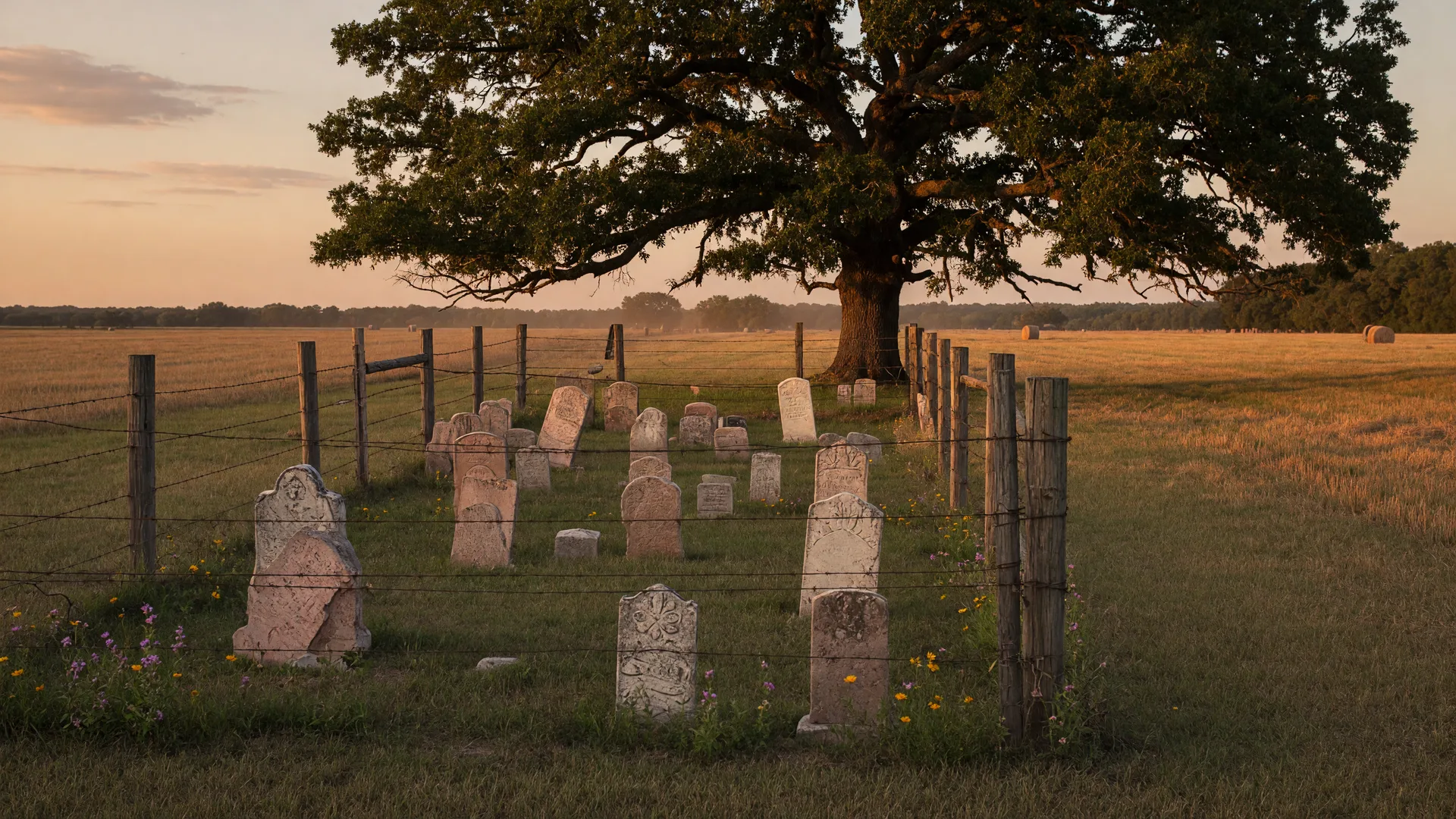
Old family cemeteries and unmarked gravesites appear on rural tracts in Northeast Texas and Southeast Oklahoma more often than most buyers expect, and they carry real legal weight. In Texas, a single burial can dedicate land to cemetery use under Health and Safety Code Chapter 711, which means the burial ground stays protected, descendants keep a legal right of access, and you generally cannot build over it without a court order and state permits. In Oklahoma, a family cemetery creates a permanent easement against the title and relatives keep statutory visitation rights under Title 8, Section 187. A cemetery is not automatically a reason to walk away from a property, but it is a due-diligence item you want to find before you close, not after.
When a buyer tells us they found an old fenced plot in the back pasture, or a surveyor flags a cluster of stones in a tree line, the first reaction is usually worry. The second question is almost always the same: what does this mean for the property, the price, and the deal? The short answer is that a cemetery on a rural tract is a specific, well-understood legal situation, not an open-ended problem. Texas and Oklahoma both protect burial grounds, both give descendants a path to visit them, and both make it hard, though not impossible, to build over them. What matters is knowing the plot is there and getting the title and county records to tell you exactly what it includes.
A cemetery or gravesite on rural land is dedicated, protected property in both Texas and Oklahoma, and it travels with the title no matter who owns the surrounding acreage. In Texas, Health and Safety Code Chapter 711 prevents the owner from disturbing the burial ground, gives family members a right of reasonable access under Section 711.041, and requires a court order plus a state permit before remains can be moved. In Oklahoma, Title 8, Section 187 gives relatives the right to visit an abandoned cemetery, and a family burial plot is treated as a permanent burden on the title even if it was never recorded. A cemetery is usually a manageable exception, not a deal killer, but it must be found in the survey, the title commitment, and the county records before you buy.
Why the cemetery question belongs in rural due diligence
Northeast Texas and Southeast Oklahoma were settled by families who buried their own on the home place. Small family plots sit in fence corners, under post oaks, and along creek banks across Lamar, Red River, Delta, Hopkins, Fannin, and the Oklahoma counties we serve. Some are marked on old maps and in deed records. Many more exist only in family memory, or appear as a few fieldstones in a pasture that no one has touched in generations. That is exactly why the cemetery question is a tract-level due-diligence item rather than a general one: every property has to be looked at on its own, because the only way to know is to look.
The good news is that a cemetery does not make a tract unusable. We have closed on acreage with fenced family plots, and the plots become a permanent, respectful part of the property, an exception in the title work and a line on the survey. The reason to investigate early is that the plot, plus the access path to it, plus the rules around it, all become obligations the buyer inherits. That is exactly the kind of thing you want to understand before you make an offer. Our guide to walking a property before buying acreage lists the ground signs worth stopping for, and old burial markers are on that list.
Texas: what a cemetery actually means for the landowner
The starting point in Texas is Health and Safety Code Chapter 711. Under the statute, property becomes dedicated to cemetery use when one or more burials are present or a dedication is recorded in the deed records. Dedicated cemetery property may not be sold in a way that interferes with cemetery use, and it may not be used for any other purpose unless the dedication is removed by a district court or the cemetery is abated as a nuisance. In practical terms, a plot of ground with burials on it stops being ordinary pasture and starts being protected ground, even when it sits in the middle of a 100-acre tract.
The statute draws careful lines around old cemeteries. An abandoned cemetery is one not owned or operated by a cemetery organization, with no other person legally responsible for its care, and not maintained by anyone. An unknown cemetery is an abandoned cemetery evidenced by marked or unmarked graves that does not appear on a map or in the deed records, and an unverified cemetery has some evidence of interment but unverified unmarked graves. These definitions matter because they trigger both protections and duties for the landowner.
The landowner's obligation is clear: the owner of property on which an unknown or abandoned cemetery sits may not construct improvements that would further disturb the cemetery until the human remains are removed under a court order. The Texas Attorney General confirmed in Opinion KP-0317 (2020) that the law generally does not prohibit a property owner from maintaining an abandoned cemetery on their land, so long as the owner does not construct improvements that disturb it. Mowing around a plot and keeping a fence up is maintenance. Pouring a slab or running a dozer through it is not.
Disinterment is a separate and strictly regulated step. In Texas, remains may not be disinterred or removed without a permit from the Texas Department of State Health Services, and disturbing remains in an unknown or abandoned cemetery to build improvements requires that permit plus a court-ordered removal of the cemetery dedication. The Texas Historical Commission must receive notice of the court petition. This is not a paperwork shortcut; it is a deliberate legal process with notice, court review, and state oversight, which is why relocation is rare and usually happens only for a serious reason.
Texas: what to do when you discover an unknown cemetery
If you or a surveyor finds a plot that does not appear on any map or deed record, Texas law sets a specific duty. Under Health and Safety Code Section 711.011, a person who discovers an unknown or abandoned cemetery must file notice with the county clerk, and mail notice to the landowner on record, within 10 days of the discovery. The county clerk sends a copy to the Texas Historical Commission. The Texas Historical Commission publishes a notice-of-existence form and recommends recording it with the county clerk, because a recorded notice is what lets future buyers and title companies see the cemetery in the deed records.
For a buyer, the filing duty is worth knowing for two reasons. First, if you discover a plot after closing, you have an obligation to report it, and the county clerk and the Texas Historical Commission are the offices to contact. Second, the recorded notice is a gift to the next owner: a tract with a properly recorded cemetery is a tract where the title work, the survey, and the seller's disclosures can all tell the story cleanly. That is a much easier purchase than one where the plot surfaces mid-deal.
Texas: descendant access rights and what they mean for you
The protection that surprises buyers most is access. Under Health and Safety Code Section 711.041, any person who wishes to visit a cemetery or private burial grounds with no public ingress or egress has the right of reasonable ingress and egress at a reasonable time, with proper notification to the property owner. The landowner may designate the route and reasonable visiting times. The Texas Historical Commission's guidance on cemetery access, desecration, and abandonment suggests visitors provide written notice to the landowner and keep a copy, and it confirms the landowner's right to set the route and hours.
For a buyer, this means the cemetery plot carries an access easement of sorts: a family member can legally come to the property, with notice, to visit the plot, and the buyer cannot fence them out or unreasonably block the path. In practice, families usually coordinate, and the visits are respectful and occasional. But the right exists, and it belongs in the same bucket as the easements you review before buying land. It is one more reason to know the plot's location and the access route before you close, and one more reason the survey matters. Our answer on whether you need a survey when buying land in Texas explains why a survey is the tool that maps the plot and its access for everyone.
How a cemetery shows up in your search
Cemeteries rarely hide from a buyer who looks in the right places. They show up in four places, and a thorough search checks all of them:
- The title commitment and deed chain. Look for a cemetery reservation, an exception for a burial ground, or a reserved access path. In Texas, a recorded dedication or notice of existence appears in the deed records, and the title commitment will flag it. This is the cleanest evidence, and it is why checking for deed restrictions and recorded exceptions is a first step on any rural purchase.
- The survey. A boundary survey will show a fenced burial plot if it is within the tract, and a good surveyor will flag unusual features, including stones or depressions that may mark graves. Unmarked graves can extend beyond visible markers, so the surveyor should map the full burial area, not just the fence.
- The ground itself. When you walk the property, look for a small fenced or stone-bordered plot, upright stones, fieldstone markers, concrete blocks, or clusters of yucca, cedar, or daffodils in odd places. Old plantings are a strong clue on a rural tract.
- County and historical records. Ask the county clerk about recorded notices, check historic maps and aerial photos, and talk to neighbors and the local historical or genealogical society. Long-time neighbors often know exactly where the old plot is and whose family it holds.
None of these steps are exotic. A title search, a survey, and a walk of the property are already standard due diligence on acreage, and the cemetery question rides along with them. Our answer on what to know before buying rural property walks the full list of checks, and the land and acreage section of the Answer Book keeps the related pieces in one place.
What the discovery means for your plans
When a cemetery is found, the practical question is always: can I still do what I planned? The honest answer is that it depends on where the plot sits and what is planned, and every tract is different. A fenced plot in a fenced corner, with the access route preserved, changes very little. A plot that sits exactly where a buyer hoped to place a shop or a pond changes a lot, because the ground is protected and the removal process is a court proceeding, not a permit line.
The property itself still sells, finances, and appraises. The cemetery is normally carved out as an exception in the title work, which means the buyer takes the tract subject to the protected plot, and the plot does not transfer as buildable ground. Walk through the exact exception with your title company or closing attorney before you commit, because the wording tells you what the plot includes and who holds access rights. And on the tax side, your county appraisal district can tell you how a fenced cemetery area is treated on the valuation roll for the tract, which is worth asking about when you review the property's county land records and valuation.
One caution that comes up with older tracts: a plot can sit on a property line, straddle two properties, or be accessible only across a neighbor's land. That is when the cemetery question turns into an access question, and the two are best handled together. Our answers on what landlocked property means and easements before you buy explain how access rights are documented, because a burial plot with no legal path is exactly the kind of detail that surfaces on a survey and gets resolved before closing.
Oklahoma: the differences to know before you buy
If you are looking at acreage in Southeast Oklahoma, the state law changes, and the changes matter for buyers. Under Oklahoma Title 8, Section 187, any relative of the deceased has the right of reasonable ingress and egress to visit an abandoned cemetery that is completely surrounded by privately owned land with no public access, after first making a good-faith effort to notify the owner or tenant. Oklahoma defines an abandoned cemetery as a place where no body has been interred for at least 25 years and that is readily identifiable as a cemetery by inspection of the property.
The Oklahoma courts and legal guidance take the title question even further than Texas in one respect. The Oklahoma Historical Society's cemetery fact sheet explains the state's position that a family cemetery creates a permanent easement against the title even when it was never written into a deed, and that a purchaser is treated as having inspected the property they bought. In plain terms, the plot travels with the land, and the buyer is presumed to have known about it. That makes the walk, the survey, and the county records even more important on the Oklahoma side of the Red River.
Disinterment in Oklahoma runs through the Oklahoma State Department of Health, which issues disinterment permits under 63 O.S. Section 1-319 and the rules in OAC 310:105-7-2. An application needs the next of kin's signature or a certified court order, and relocating an entire cemetery requires a blanket permit from the State Department of Health under OAC 310:105-7-4, with a court order where next of kin cannot be located. Willfully damaging or destroying a cemetery is also a crime under Oklahoma law, so the respectful-buffer rule applies with real teeth.
The two-state picture matters for anyone looking on both sides of the border. Our answers on the differences between buying rural property in Texas and Oklahoma and what Texas buyers should know before buying land in Oklahoma cover the other ways the two states diverge, from water rights to surveys to closing practice. The cemetery rule is one more reason a two-state purchase deserves a local agent on both sides of the line.
Checklist before you buy
A cemetery on a rural tract is a findable, manageable due-diligence item. Here is the checklist we use with land buyers in both states:
- Read the title commitment for cemetery exceptions. Ask your title company to point out any cemetery, burial ground, or reservation language in the deed chain and what it covers.
- Order and review the survey. Confirm the surveyor mapped any fenced plot, stone cluster, or unmarked burial area, and note how the access path is drawn.
- Walk the property. Look for a fenced or bordered plot, upright or fieldstone markers, and old plantings. In Oklahoma, remember the law treats the buyer as having inspected the property.
- Check the county clerk. Ask about recorded cemetery notices and dedications. In Texas, a discovered unknown cemetery must be reported to the county clerk within 10 days, so confirm nothing is pending.
- Ask the seller and the neighbors. Long-time neighbors know the old plots, whose family they hold, and whether descendants still visit.
- Review access. Confirm the plot and any visiting route are on the tract you are buying, and read any access reservation in the title work.
- Talk to your attorney about the exception. Cemetery wording is specific, and a closing attorney who knows rural property is worth the call.
The same checklist works whether the tract is in Lamar, Red River, Delta, Hopkins, or Fannin County, or in Bryan, Choctaw, or McCurtain County on the Oklahoma side. County record-keeping practices differ, but the questions are the same, and that is why this is a tract-by-tract verification rather than a generalization. When a plot is properly recorded and respected, it rarely changes a deal; it simply becomes part of the property's history, which in this part of the country is usually part of why people buy land here in the first place.
The bottom line
A cemetery or old gravesite on rural land is protected property in both Texas and Oklahoma, and the protection travels with the title. In Texas, Health and Safety Code Chapter 711 dedicates the ground, requires a court order and a state permit before remains can be moved, and gives descendants a right of reasonable access under Section 711.041. In Oklahoma, Title 8, Section 187 preserves visitation rights for relatives, and a family plot is treated as a permanent burden on the title. The practical result is the same on both sides of the Red River: find the plot, read the title exception, map it on the survey, and plan around it. A fenced, recorded, respected cemetery is usually a small and manageable part of a rural property, and it should never be a surprise discovered after closing.
That is the kind of ground-level due diligence we do with every land buyer, from the first county records pull to the final title review. If you are weighing acreage in Northeast Texas or Southeast Oklahoma and want help checking the records, walking the tract, and reading what the survey and title tell you, call the Shannon Miles Group at (903) 785-2005 or stop by the office at 2322 Lamar Ave. in Paris. Our land and ranch service page covers how we work across the region, and the acreage page is where buyers usually start. For the wider due-diligence picture on rural property, the Lamar County land and rural property guide ties the county-level records, the Answer Book, and the practical checklist together in one place.
This guide draws on primary and institutional sources. Cemetery law is set by state statute and administered by state agencies and county clerks, and it changes over time, so always confirm the current rules for your exact tract with the county clerk, the Texas Historical Commission or Oklahoma Historical Society, the relevant state health department, and a closing attorney before you buy.
- Texas Health and Safety Code Chapter 711, Cemetery Regulation
- Texas Health and Safety Code Section 711.001, Definitions
- Texas Health and Safety Code Section 711.041, Access to Cemeteries
- Texas Historical Commission, Cemetery Discovery and Notice of Existence
- Texas Historical Commission, Cemetery Laws: Access, Desecration, and Abandonment
- Texas Historical Commission, Cemetery Laws Overview (PDF)
- Texas Attorney General Opinion KP-0317 (June 2020)
- Oklahoma Title 8, Section 187, Abandoned Cemeteries and Visitation Rights
- Oklahoma Historical Society, State Historic Preservation Office Cemetery Fact Sheet
- 63 O.S. Section 1-319, Disinterment and Reinterment
- OAC 310:105-7-2, Permit Required for Disinterment
- OAC 310:105-7-4, Relocation of Cemeteries
- Oklahoma State Department of Health, Request for Disinterment Permit
Frequently Asked Questions
What happens if there is a cemetery on rural land I want to buy in Texas?
In Texas, a cemetery on private land is dedicated property under Health and Safety Code Chapter 711. The burial ground stays protected, descendants and family members keep a legal right of reasonable access, and the owner generally cannot build improvements that disturb the remains without a court order and a state permit. The rest of the tract can still be bought, sold, and used normally, with the cemetery area carved out as an exception in the title work.
Can I build over an old cemetery on my property in Texas?
Generally no. Texas Health and Safety Code Chapter 711 prohibits constructing improvements that would further disturb an abandoned or unknown cemetery until the remains are removed under a court order, and disinterment requires a permit from the Texas Department of State Health Services. A cemetery dedication can be removed only by a district court, and the Texas Historical Commission must receive notice of the petition.
Do descendants have a right to visit a private family cemetery?
Yes. Under Texas Health and Safety Code Section 711.041, anyone who wishes to visit a cemetery or private burial grounds with no public access has the right of reasonable ingress and egress at reasonable times with proper notification to the property owner, who may designate the route and reasonable visiting times. Oklahoma provides a similar visitation right for relatives under Title 8, Section 187.
What should I do if I discover an unknown cemetery on rural land?
Under Texas Health and Safety Code Section 711.011, a person who discovers an unknown or abandoned cemetery must file notice with the county clerk and mail notice to the landowner on record within 10 days of discovery. The county clerk sends a copy to the Texas Historical Commission, and recording the notice lets future buyers and title companies see the cemetery in the deed records.
How does Oklahoma law treat a family cemetery on private land?
In Oklahoma, a family cemetery is treated as a permanent burden on the title even when it is not written in the deed, and relatives of the deceased keep a statutory right of reasonable access to visit an abandoned cemetery under Title 8, Section 187. Disinterment or relocation requires a permit from the Oklahoma State Department of Health, and willfully damaging a cemetery is a crime.
Buying rural land in Northeast Texas or Southeast Oklahoma?
We will help you pull the county records, review the survey and title exceptions, and walk the tract so nothing about the property is a surprise after closing. Call (903) 785-2005 or send us a message.

Shannon Miles Group
eXp Realty | Paris, TX
Shannon and Scott Miles are a husband-and-wife real estate team serving Northeast Texas and Southeast Oklahoma. As founding members of the eXp Land and Ranch Division, they specialize in land, ranch, residential, commercial, and new construction across Lamar County and beyond.