
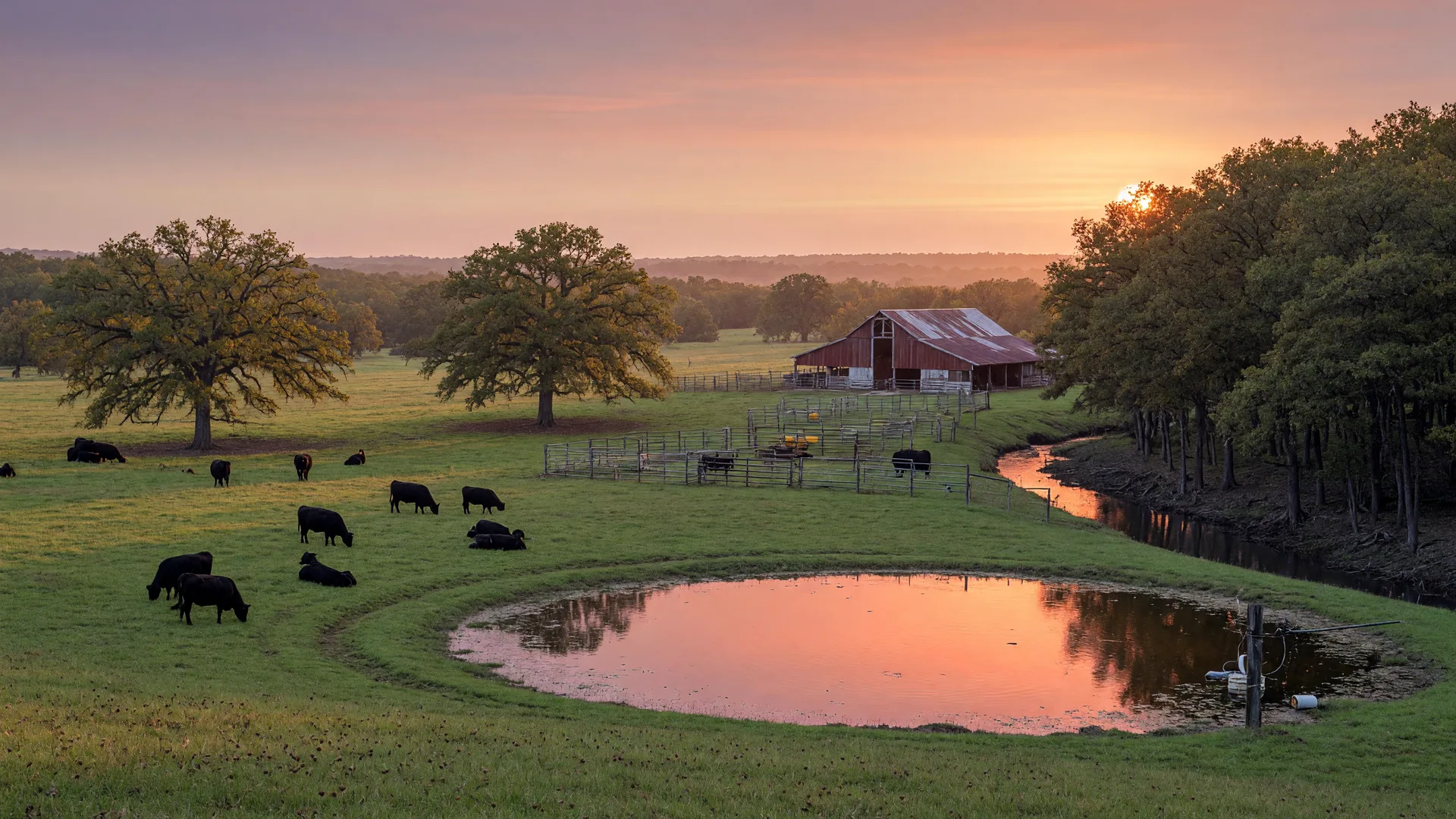
In the most recent published data from the Texas A&M Real Estate Research Center, the price per acre for rural land in the Northeast Texas region was $8,604 in the second quarter of 2026, down 5.96% from a year earlier. Statewide, Texas rural land averaged $5,218 per acre in the same quarter, up 3.27% year over year. The figures come from TRERC's Texas Rural Land Markets report, published August 20, 2026, and they reflect verified closed sales.
That number is a regional starting point, not a price tag for any specific tract. Ranch and acreage pricing in this part of Texas varies widely from county to county and from one property to the next. Water, fencing, improvements, agricultural valuation, mineral ownership, and usable acreage all move the number. This guide explains where the figures come from, what they include, and how to use price per acre without being misled.
Shannon and Scott Miles are founding members of the eXp Land and Ranch Division and work with ranch, acreage, and rural luxury property across Northeast Texas and Southeast Oklahoma from their office at 2322 Lamar Ave. in Paris, TX. The land and ranch service page explains how they evaluate these properties, and this post walks through the market data behind the acreage conversation.
What the Data Says for Northeast Texas
The most authoritative published figures come from the Texas A&M Real Estate Research Center (TRERC), which tracks rural land sales by region using verified closed transactions. Northeast Texas is TRERC's Region 4, covering Lamar, Red River, Delta, Hopkins, Fannin, Hunt, and surrounding counties. Their figures:
- Second quarter 2026 (most recent): $8,604 per acre, down 5.96% year over year. (Source: TRERC, Texas Rural Land Markets, Second Quarter 2026, published August 20, 2026.)
- Third quarter 2025 (the recent peak): $9,313 per acre, up 4.4% year over year. (Source: TRERC, Rural Land, Winter 2026 report.)
- Full-year 2025: the Texas Farm Credit Land Pricing Guide (2026 edition) reports a Northeast Texas average of $9,313 per acre, with values ranging from roughly $7,500 to $15,000 per acre depending on location and tract characteristics.
- Historical context: TRERC reported $9,073 per acre for the region in the second quarter of 2025, up 3.69% year over year, before the recent cooling.
These are regional prices for rural land sales, not asking prices. Listing-based marketplaces often show higher per-acre numbers because they reflect what sellers are asking, not what buyers have paid. When you read a per-acre figure anywhere, check whether it is based on closed sales or active listings, and check the date. Rural land data moves slowly, but it does move, and the most recent TRERC reading shows the region moderating from its 2025 peak. For the county-by-county asking-price picture, the team's October 2026 market report pairs the verified TRERC data with active-listing inventory across the eight counties.
Why Price Per Acre Varies So Much From Tract to Tract
Two similar-looking tracts in the same county can carry very different per-acre values. The features that move the number most in Northeast Texas:
- Water. A year-round creek, a stocked pond, or a high-producing well supports livestock, wildlife, and self-sufficiency. Water is the single most consistent premium in rural land pricing.
- Usable acreage. A tract with creek bottom, timber, and wet ground may carry fewer usable acres than its deed acreage suggests. Buyers and appraisers compare usable ground, not just gross acres.
- Improvements. Cross fencing, working pens, hay barns, shops, and covered livestock facilities save a buyer years of development. They add value, though rarely dollar for dollar.
- Agricultural valuation. Land enrolled in Texas open-space (ag or wildlife) valuation is assessed on productive capacity, not market value, which lowers annual carrying costs and can support a stronger price per acre. The ag-exempt ranch guide explains how this works.
- Access and frontage. Paved county road frontage, a legal recorded easement, and utilities at the line all command a premium over landlocked or utility-poor tracts.
- Minerals and timber. Ownership of minerals and timber rights is rarely priced into the surface acre, but it shapes what the land is worth to different buyers. The mineral rights guide covers what to verify.
County location matters too. Tracts closer to growing markets such as Sherman, Celina, and Frisco in Grayson and Collin Counties tend to price higher per acre than comparable ground in Delta or Red River Counties. The Lamar County land and rural property guide walks through the local market in the team's home county, and the Southeast Oklahoma page covers the Oklahoma side of the region, where per-acre numbers follow different data.
How to Use Price Per Acre Without Being Misled
Price per acre is a useful starting point, but it is only a starting point. The buyers who make good decisions compare like for like: usable acres against usable acres, watered ground against watered ground, improved tracts against improved tracts. Our answer on how vacant land is valued explains why a raw per-acre comparison can mislead, and the ranch comparison framework lays out the checklist buyers should run before they decide.
For sellers, the same discipline applies in reverse. Pricing a ranch or acreage tract is not a matter of finding a regional average and multiplying. It is a matter of finding the closed sales that actually compare to your property, then adjusting for the features that differ. The selling land and acreage guide covers how that pricing conversation works for sellers, including how unique properties with few comparable sales are handled.
What This Means for Buyers and Sellers Right Now
The published data shows Northeast Texas rural land moderating from its 2025 peak: TRERC's Q2 2026 reading of $8,604 per acre is down 5.96% year over year, while the statewide average rose 3.27% to $5,218 per acre in the same quarter. The region's longer-run appreciation trend is still positive, and sales activity has cooled rather than collapsed. Those are regional figures, and they are the most recent institutional numbers available as of this writing. County-level and tract-level values still vary widely, and any specific property should be evaluated on its own facts.
For buyers, the practical takeaway is that Northeast Texas remains one of the more accessible rural markets in the state, and the per-acre figures confirm it. For sellers, the takeaway is that the market rewards properties that are documented, marketed, and priced against real comparable sales. A land and ranch specialist who works the region daily can pull the actual closed sales for your county and your property type, which is worth more than any regional average.
The Shannon Miles Group works with ranch, acreage, hunting, equestrian, and rural luxury property across Lamar, Red River, Delta, Hopkins, Fannin, Grayson, Hunt, and Collin Counties, and through Scott Miles' Oklahoma license, across Southeast Oklahoma. Whether you are buying your first tract or selling a legacy ranch, the conversation starts the same way: with the property's own facts, and the sales that actually compare to it.
Sources and Last Updated
Geographic scope: Northeast Texas (TRERC Region 4, including Lamar, Red River, Delta, Hopkins, Fannin, Hunt, and surrounding counties). Property type: rural land, ranch, and acreage sales. Data sources:
- Texas A&M Real Estate Research Center, Texas Rural Land Markets, Second Quarter 2026 (Region 4: $8,604 per acre): trerc.tamu.edu/reports/texas-rural-land-markets-second-quarter-2026/
- Texas A&M Real Estate Research Center, Rural Land, Winter 2026 (Region 4: $9,313 per acre in Q3 2025): trerc.tamu.edu/article/rural-land-winter-2026/
- Texas A&M Real Estate Research Center, Texas Rural Land Markets, Second Quarter 2025 (historical context, $9,073 per acre): trerc.tamu.edu/reports/texas-rural-land-markets-second-quarter-2025/
- Texas Farm Credit, Texas Land Pricing Guide (2026 edition): texasfarmcredit.com/resources/texas-land-pricing-guide/
Last updated: October 14, 2026. Regional land market data is published quarterly and annually; figures here reflect the most recent published reports available on that date. For a current read on a specific tract or county, ask for the comparable closed sales rather than relying on a regional average.

Shannon Miles Group
eXp Realty | Paris, TX
Shannon and Scott Miles are a husband-and-wife real estate team serving Northeast Texas and Southeast Oklahoma. They are founding members of the eXp Land and Ranch division, hold the GRI designation, and Shannon is a Certified Luxury Home Marketing Specialist (CLHMS). Based at 2322 Lamar Ave. in Paris, TX, they help buyers and sellers of ranch, acreage, hunting, equestrian, and rural luxury property across the region.